70s fashion: the looks and how to wear them now
In this guide
Can you wear flared jeans without looking dressed for a theme night? Almost always, because 70s fashion is one of the easiest decades to borrow from. So many of its pieces never really left: flares, suede jackets, turtlenecks, wrap dresses and corduroy all still hang in ordinary shops, and if a party asks you to come dressed in 70s style, much of the outfit may already be in your closet.
What trips people up is that the decade was not one look. It moved from hippie and prairie dressing, through a polished and glamorous disco period, to punk and a practical menswear influence at the end. This guide takes those looks one at a time for women and men, then shows how to build a 70s outfit from clothes you already own and how to wear the ideas every day.
What defined 70s fashion
The Museum at FIT calls the 1970s the polyester decade, and synthetic fabrics were everywhere, but the more useful idea is freedom. After the 1960s, there was no single correct hem length or silhouette. Miniskirts, midi skirts and maxi dresses were all worn at the same time, trousers became normal for women in more settings, and men's clothes took on color, pattern and flare in what was called the Peacock Revolution.
Across the decade, a few shapes repeat. Trousers were close through the hip and wide at the hem. Collars were long and pointed, lapels and ties were wide, and platform soles added height for everyone. Colors began bright and psychedelic, then settled into the earth tones people now associate with the period: rust, mustard, olive, chocolate brown, burnt orange and cream. Textures mattered too, with suede, corduroy, denim, crochet and knit all common.
Early 70s: hippie, boho and prairie looks
The early years carried the counterculture forward: tie dye, embroidered peasant blouses, patched and embroidered denim, fringed suede vests, long flowing maxi skirts and headbands. Alongside this came a romantic, almost Victorian strand, with high necked prairie dresses in small floral prints. Hot pants, very short fitted shorts, also had a brief moment early in the decade, usually with tights or boots.
This period is the root of what is now sold as boho, and our guide to boho style shows how it is worn today. A typical early 70s outfit for women is a peasant blouse tucked into high waisted flared jeans, with a wide belt, sandals or clogs and a long pendant. For men, it is a loose printed shirt open at the collar, flared jeans, a suede or denim jacket and boots. Our guide to hippie style goes further into the counterculture roots.
70s disco fashion
By the middle of the decade, nightlife set the tone. Studio 54 opened in 1977 and made regulars such as Bianca Jagger into style references, while Halston's fluid jersey dresses and sequins defined evening glamour. The disco uniform for women was a slinky halter neck dress or jumpsuit, sequined tops, satin trousers and high platform sandals, with lots of shine. Diane von Fürstenberg's jersey wrap dress, introduced in 1974, became the daytime version: fitted, easy to move in and flattering on many figures.
For men, Saturday Night Fever (1977) fixed the image: a white three piece suit with wide lapels, a shirt with a long pointed collar worn open over the jacket, sometimes a gold chain, and heeled shoes. The more casual cousin was the leisure suit, a matching jacket and trousers in polyester, often in powder blue or brown. For a 70s disco party outfit, anything that shines, flares or plunges will read clearly; our guide to satin explains the fabric behind much of that shine.
70s fashion for women: day looks
Away from the dance floor, women's everyday clothes were practical and increasingly borrowed from menswear. Pantsuits became acceptable office wear, and the film Annie Hall (1977) made men's waistcoats, loose trousers, a tie and a man's hat look fresh on a woman. Other staples were fitted ribbed turtlenecks, cardigans and sweater vests, high waisted wide leg trousers, denim skirts, shirtdresses, knee high boots and platform shoes.
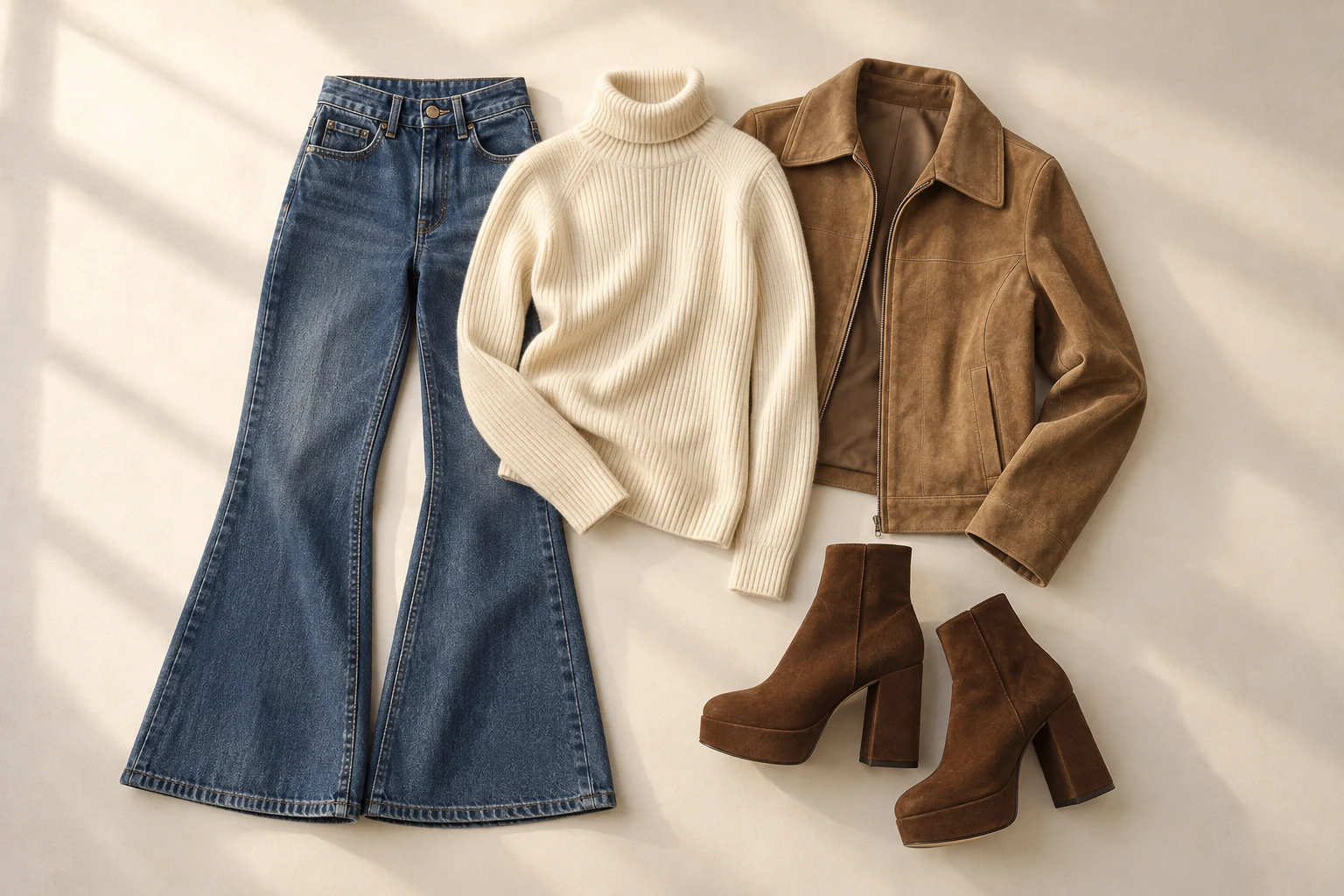
Late in the decade, designer jeans from names such as Calvin Klein and Gloria Vanderbilt turned denim into a fashion item rather than workwear. A reliable 70s outfit for women today is a ribbed turtleneck or a blouse with a big collar, high waisted flared jeans or wide trousers in a warm color, a suede jacket and heeled boots. Our guide to styling wide leg trousers helps with proportions, since the high waist and full hem are what make the look.
70s fashion for men
Men's clothes in the early 70s were slim through the body and flared below the knee. Turtlenecks under blazers, patterned shirts with long collars, corduroy and denim jackets, and suits with wide lapels and wide ties were all standard. The safari suit, a belted jacket with patch pockets, was popular enough to turn up in James Bond films, and denim or plaid suits appeared too. By the late decade, tracksuits and athletic wear moved into everyday life.
For a party, the quickest men's look is a printed or satin shirt with a big collar worn open, flared trousers and boots, with a leather or suede jacket if you have one. For everyday wear, a brown corduroy jacket over a cream turtleneck with straight or slightly flared jeans captures the decade quietly. Our guide to corduroy covers how to choose and care for it.
| Look | Women | Men |
|---|---|---|
| Hippie and prairie | Peasant blouse, flared jeans, wide belt, clogs, long pendant | Loose printed shirt, flared jeans, suede or denim jacket, boots |
| Disco | Halter dress or jumpsuit, sequins, satin trousers, platform sandals | White suit with wide lapels, open long collar shirt, heeled shoes |
| Day wear | Ribbed turtleneck, high waisted wide trousers, suede jacket, heeled boots | Corduroy jacket, cream turtleneck, straight or slightly flared jeans |
| Late decade | Menswear pieces, pantsuits, designer jeans | Leisure suits, safari suits, tracksuits |
Earth tones such as rust, mustard, olive and brown tie every one of these looks to the decade.
How to dress 70s with normal clothes
Start with the trousers, because the flare is the strongest signal. Flared, bootcut or wide leg jeans or trousers worn with a high waist do most of the work; our guide to types of jeans explains which cuts come closest. Then add one period top: a turtleneck, a blouse with a big collar or a pussy bow, a fitted knit or a patterned shirt. Finish with texture and color, such as suede, corduroy, a crochet vest, or anything in rust, mustard, olive or brown.
Shoes and accessories complete the picture. Platform shoes, clogs, heeled boots and suede ankle boots all fit, as do tinted aviator sunglasses, a wide leather belt, hoop earrings and a long pendant. Thrift and vintage shops are full of genuine 70s shirts and jackets, and a real piece often looks more convincing than a costume shop version. Check vintage polyester for yellowing at the underarms before you buy.
Wearing the 70s without a costume
For everyday wear, let one element carry the reference and keep the rest current. Flared jeans with a plain white T shirt and a modern jacket, a wrap dress with simple sandals, or a suede jacket over a gray hoodie and straight jeans all nod to the decade without announcing it. Avoid combining flares, a big collar, platforms and a headband in one outfit unless it is a party.
Proportion is the part people get wrong. Flares need a shoe with some height under them, so the hem nearly grazes the floor instead of pooling on the ground; if you wear them with flats, have them hemmed shorter. Earth tones are easy to mix with each other and with denim, cream and navy, and our guide to colors that go together helps if you want to add one brighter accent.
Questions people ask
What is a typical 70s outfit?
For women, high waisted flared jeans with a peasant blouse or ribbed turtleneck, a suede jacket and platform shoes or boots. For men, a patterned shirt with a long pointed collar, flared trousers and a corduroy or leather jacket. Earth tones such as rust, mustard and brown tie either version together.
How do I dress for a 70s party?
Choose disco or hippie and commit to it. Disco means shine: a halter dress, jumpsuit or satin shirt, flares and platforms. Hippie means flowing and handmade: a peasant blouse or fringed vest, flared jeans, a headband and sandals.
What tops did people wear in the 70s?
Peasant blouses, ribbed turtlenecks, halter tops, tube tops, wrap tops, shirts with long pointed collars, tight T shirts, crochet vests and sweater vests. Printed shirts in bold patterns were common for men, often worn open at the neck.
How is 70s fashion different from 80s fashion?
The 70s were long, lean and flared, with soft fabrics and earth tones. The 80s turned structured and bright, with big shoulders, neon and pastels. Our guide to 80s fashion covers what came next.
What was the biggest fashion craze of the 70s?
Bell bottoms and platform shoes are the two things almost everyone wore at some point, across genders and scenes. Disco clothing was the most visible craze in the middle of the decade, and designer jeans took off at the end.
Sources and further reading
References used for this guide. Each opens the original page in a new tab.
Keep reading
Styles
80s fashion: key looks for men and women
The key looks of 80s fashion for women and men, from power suits and aerobics wear to Miami Vice and hip hop, plus how to make an 80s outfit from normal clothes.
Styles
Boho style: pieces, fabrics and how to wear it
What boho style means, where it came from, the key pieces and fabrics of boho clothing, and outfits for everyday, weddings and every age without a costume look.
Styles
Hippie style: from the 1960s to now
What hippie style is, where it came from in 1960s San Francisco, the key pieces and fabrics, and how men and women can wear it today without looking like a costume.
Everyday style
Types of jeans: fits and cuts explained
The main types of jeans explained: rise, skinny to baggy leg shapes, bootcut, flare, wide leg, mom and boyfriend jeans, with what each suits and how to wear it.
Styles
Punk fashion: where it came from and how to wear it
What punk fashion is, how it started in 1970s New York and London, the pieces and substyles that define it, and how to build punk outfits for men and women today.