Types of sleeves, from cap to bishop
In this guide
Flutter sleeve, says the product description. Two piece bishop sleeve, says the sewing pattern. And a favorite blouse keeps pulling tight across the back for reasons nobody explains. Sleeves have a surprising number of names, but the types of sleeves become easy to sort once you see that every name describes one of three things: how the sleeve is attached, how long it is, or what shape it takes.
Taking those three layers in order makes almost any sleeve name readable, and the fuller shapes then come down to a few practical questions about coats and daily life. The names come from dressmaking, so they apply to shirts, knits and jackets as well as dresses, and to menswear too, even though men's clothing uses a much smaller set.
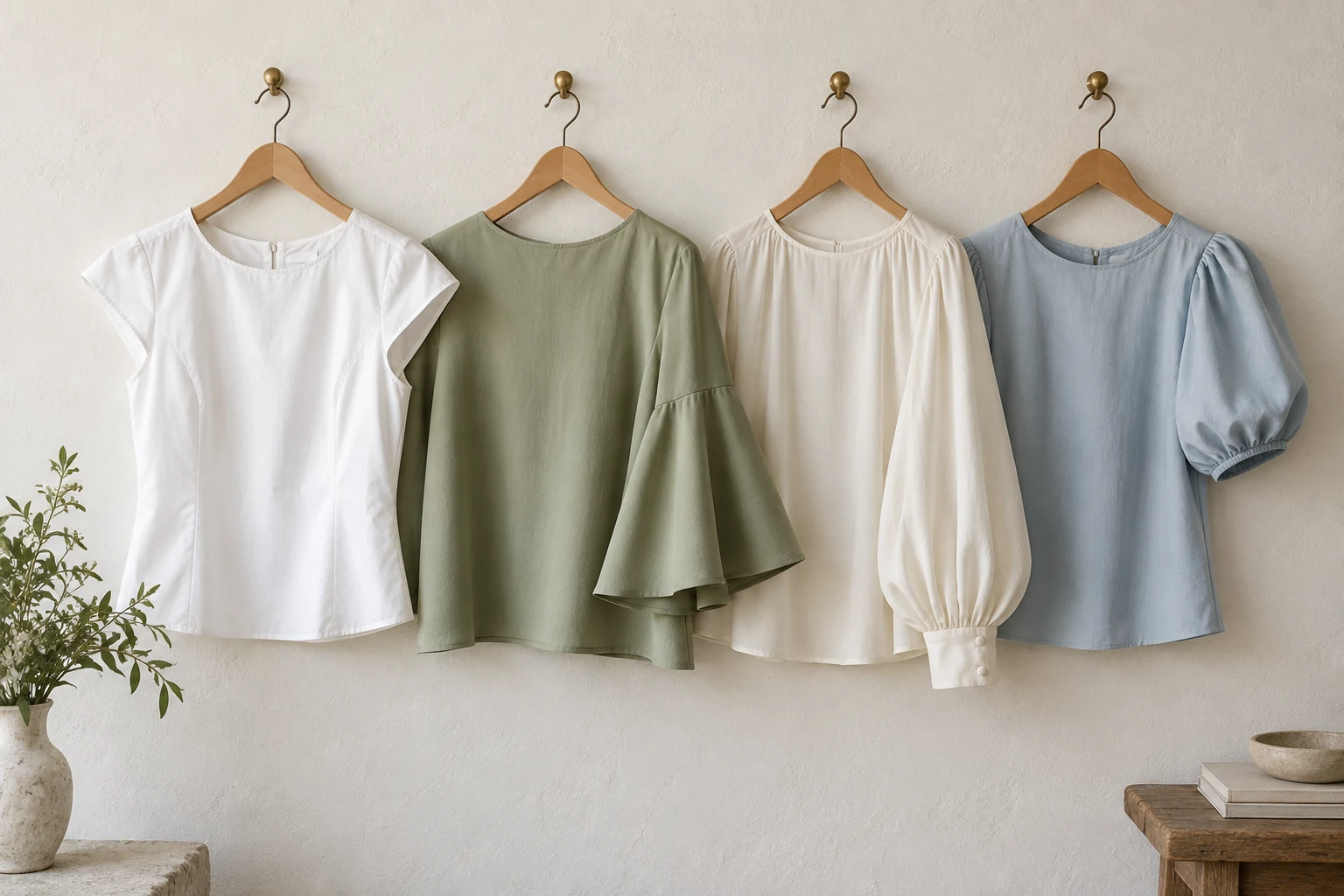
The three basic types of sleeves
The set in sleeve is the most common construction. The sleeve is a separate tube with a rounded top, called the cap or head, which is eased into a round armhole and sewn to the body along a seam that circles the shoulder. It gives the neatest, most tailored shape, which is why nearly all blazers, dress shirts and fitted dresses use it. The trade off is movement: the higher and closer the armhole, the more precise the fit has to be, and a set in sleeve that is cut too small is the usual reason a blouse pulls across the back when you reach forward.
A raglan sleeve has a diagonal seam that runs from the underarm up to the neckline, so the sleeve includes part of the shoulder. The style is named after Lord Raglan, the British commander who is said to have worn a coat cut this way after losing his arm at Waterloo. Because there is no seam sitting on the point of the shoulder, raglans move easily and fit a wide range of shoulder shapes, which is why they appear on sweatshirts, baseball shirts and many sweaters. The diagonal lines also soften a square shoulder.
Kimono and dolman sleeves are cut in one piece with the front and back of the garment, with no armhole seam at all. A kimono sleeve usually falls in a straight, wide line; a dolman, also called a batwing sleeve, starts very deep, sometimes near the waist, and narrows to a fitted wrist. Some sewing references treat dolman as its own fourth family. The drop shoulder, common on oversized knits and T shirts, is a set in sleeve whose seam has been moved down onto the upper arm, which gives a relaxed, slouchy line without the full volume of a dolman.
Sleeve lengths, from cap to full length
Length names are the most practical to know because they tell you what the garment will cover. A cap sleeve is the shortest: a small extension that covers the top of the shoulder and ends above the underarm, so there is often no sleeve fabric under the arm at all. A short sleeve ends partway down the upper arm, as on a T shirt. An elbow sleeve stops at or just above the elbow. A three quarter sleeve ends between elbow and wrist, and a bracelet sleeve a little shorter than full length so that a bracelet or watch shows. A full length sleeve reaches the wrist bone.
Cap sleeves deserve their own note because they are everywhere: on T shirts, fitted tops and a great many wedding dresses. On a wedding dress, cap sleeves give a little coverage for a ceremony without the warmth of a full sleeve, and they often come in lace or sheer illusion fabric. On knits, a cap sleeve can be a separate piece or simply the body cut slightly wider at the shoulder. They sit best when the edge ends just past the shoulder point; if yours stands away from the arm, the garment is probably too big across the shoulders.
Sleeveless is a length too. A cut in or racer shoulder moves the armhole inward to show more shoulder, while a halter removes the shoulder seam entirely. Our guide to types of necklines covers those shapes, since they are really defined by the neckline.
Full sleeve shapes: bell, bishop, puff and more
Bell sleeves are fitted from the shoulder to around the elbow and then flare toward the hand, like the mouth of a bell. A top or blouse with bell sleeves in a soft crepe gives movement without bulk, and bell sleeves on a dress are a romantic detail that returns to fashion every few years. A trumpet sleeve is the same idea with the flare starting lower. A flutter sleeve is a short, loose, often circular piece that ripples over the upper arm.
A bishop sleeve does the opposite of a bell: it is narrow at the shoulder and fuller toward the bottom, where the fullness is gathered into a cuff at the wrist. That gathered cuff is what keeps it practical, since it cannot fall into your food. A lantern sleeve keeps the top plain and balloons out below the elbow before gathering in again, and a balloon sleeve puffs along its whole length.
Puff sleeves are gathered at the shoulder, and often at the hem, so they rise into a rounded volume; historical fashion used them heavily, and today they appear on blouses, summer dresses and bridesmaid dresses. Leg of mutton, also called gigot, is the exaggerated Victorian version: huge over the upper arm and tight from elbow to wrist, famous from the 1890s. A Juliet sleeve combines a short puff at the top with a long fitted sleeve below. Batwing sleeves, described above as a construction, are also a shape in their own right: a top with batwing sleeves drapes into soft folds under the arm when your arms are down and makes a wide wing shape when they are raised.
| Sleeve | Shape | Everyday ease |
|---|---|---|
| Bell | Fitted to the elbow, then flares | Soft crepe works; stiff wide bells are hardest |
| Bishop | Fuller toward the bottom, gathered into a cuff | The easiest full sleeve for daily life |
| Lantern | Plain top, balloons below the elbow, gathered in | Moderate |
| Puff | Gathered at the shoulder into rounded volume | Crushes under a fitted blazer |
| Leg of mutton | Huge upper arm, tight from elbow to wrist | A statement, draws the eye to the shoulders |
| Flutter | Short, loose and rippling over the upper arm | Easy in warm weather |
| Batwing | Deep from near the waist, fitted at the wrist | Drapes in soft folds under the arm |
Choosing types of sleeves for dresses
Sleeves change how a dress reads more than almost any other detail. A fitted three quarter set in sleeve makes a sheath dress feel office ready. A puff or flutter sleeve on the same dress turns it toward a garden party. A long bishop or bell sleeve on a midi dress feels romantic and slightly bohemian, and a cap sleeve reads classic and neat. When you choose, think about the occasion first and then the season: long sheer sleeves are cool enough for summer evenings, while a sleeveless dress will usually need a layer in an air conditioned venue.
Volume at the shoulder, such as a puff or leg of mutton, draws the eye upward and makes the shoulders look broader. Volume at the wrist, such as a bell or bishop, moves attention down the arm and toward the hands. Neither is a correction for any body, just a way of deciding where you want the emphasis. Our guide to dressing for your body shape explains the idea of balance without rules about what anyone can wear, and checking the fit of a dress covers how a sleeve should sit at the armhole.
How to wear full sleeves day to day
The practical problem with dramatic sleeves is layering. A bell or puff sleeve will not fit neatly into a fitted blazer; it crushes and bunches at the elbow. Choose a jacket or coat with a roomy sleeve, a cape, a cardigan worn over the shoulders, or a sleeveless vest instead. If you know you will be wearing a coat all day, save the voluminous sleeves for evenings when the coat comes off. Our tour of jacket types points out which ones are cut generously enough.
Wide sleeves also meet the world more than fitted ones. They drag across plates, catch on door handles and trail into sinks. A bishop sleeve with a buttoned cuff is the easiest full sleeve for daily life; a wide bell sleeve in a stiff fabric is the hardest. Keep the rest of the outfit simple when the sleeve is the statement: a plain skirt or straight trousers and minimal jewelry at the wrist.
If you sew, the same families apply to patterns. A pattern for a bell sleeve is usually a set in sleeve with a flared lower half, and many dressmakers change a plain sleeve into a bell, bishop or puff by slashing and spreading the pattern piece to add fullness where the shape needs it.
Questions people ask
What are the three basic types of sleeves?
Set in, raglan and kimono. A set in sleeve is sewn into a round armhole, a raglan sleeve has a diagonal seam to the neckline, and a kimono sleeve is cut in one with the bodice. Dolman or batwing sleeves are sometimes listed separately as a deeper variant of the kimono.
What is the difference between a cap sleeve and a short sleeve?
A cap sleeve covers only the top of the shoulder and usually ends above the underarm, so the underside of the arm is bare. A short sleeve is a full tube of fabric that circles the arm and ends partway down the upper arm.
Are bell sleeves and bishop sleeves the same?
No. A bell sleeve is fitted at the top and flares open at the bottom with no cuff. A bishop sleeve is narrower at the top and full at the bottom, but the fullness is gathered into a cuff at the wrist, so it ends closed.
What sleeves do men's shirts and jackets use?
Mostly set in sleeves for shirts, blazers and suits, and raglan sleeves for sweatshirts, baseball shirts and many overcoats. Drop shoulder sleeves are common on relaxed knits and T shirts. Decorative shapes like bell or puff sleeves are rare in menswear.
Sources and further reading
References used for this guide. Each opens the original page in a new tab.
Keep reading
Everyday style
Types of necklines and how they frame you
A clear guide to the types of necklines on dresses, tops and sweaters, from jewel and scoop to halter, Queen Anne and apron, with jewelry and bra tips for each.
Everyday style
How to check dress fit, from shoulders to hem
How to check dress fit in a fitting room or at home: what to look for at the shoulders, bust, waist, hips and hem, how to read wrinkles, and what a tailor can fix.
Everyday style
Types of skirts and how to wear each one
The main types of skirts by shape, pleat and length, what each one is called, how to tell them apart and how to wear each one for work, weekends and evenings.

Everyday style
How to dress for your body type without the rules
How to dress for your body type using fit, proportion and balance as tools, not rules. What shape labels and Kibbe can tell you, and where they stop helping.
Everyday style
Types of jackets and when to wear them
A clear guide to the main types of jackets for men and women, from blazers and bombers to parkas and trench coats, with the fabric and weather each one suits.