How to find your dress shirt size: neck and sleeve
In this guide
A drawer full of shirts labeled medium, and not one of them closes comfortably under a tie. Or an interview on Monday, and a dress shirt size chart online asking for a neck size and a sleeve length you have never measured. Both problems have the same fix: two measurements, taken properly, and a basic understanding of how makers turn them into a size.
You need a soft tape measure, a mirror and ideally a second person for the sleeve. It takes about five minutes, and the numbers stay useful for years unless your weight changes.
What dress shirt sizes mean
A dress shirt size like 15.5 34/35 is two measurements in inches. The first, 15.5, is the neck size: the circumference of the collar when it is buttoned. The second is the sleeve length, measured from the center of the back of the neck to the end of the cuff. Many ready to wear shirts come in paired sleeve lengths such as 32/33 or 34/35, meaning the shirt is cut to work for either, while better shirts are often sold in single inch sleeves. Neck sizes go up in half inches, typically from about 14 to 18, with larger sizes from makers that offer extended ranges.
Letter sizes such as small, medium and large bundle a range of neck sizes into one, so a medium might cover a 15 and a 15.5 neck. That is fine for casual shirts worn open at the collar. For a shirt you will button to the top and wear with a tie, the neck number matters, and a letter size is a guess. European and British makers sometimes label collars in centimeters; multiplying your inch size by 2.54 gets you close, so a 15.5 inch neck is about 39 cm, but check the maker's own dress shirt size chart before ordering.
If you need to translate between the two systems, one common conversion used by several makers runs like this: small covers a 14 to 14.5 inch neck and a 34 to 36 inch chest, medium a 15 to 15.5 neck and 38 to 40 chest, large a 16 to 16.5 neck and 42 to 44 chest, extra large a 17 to 17.5 neck and 46 to 48 chest, and double extra large an 18 to 18.5 neck and 50 to 52 chest. So a 36 inch chest sits at the border of small and medium, and a 17 34/35 shirt is roughly an extra large. Brands shift these ranges, and big and tall lines add longer bodies and sleeves as well as larger necks, so use the table only as a starting point.
| Letter size | Neck | Chest |
|---|---|---|
| Small | 14 to 14.5 | 34 to 36 |
| Medium | 15 to 15.5 | 38 to 40 |
| Large | 16 to 16.5 | 42 to 44 |
| Extra large | 17 to 17.5 | 46 to 48 |
| Double extra large | 18 to 18.5 | 50 to 52 |
One common conversion; brands shift these ranges, so check the maker's own chart.
How to measure your neck size
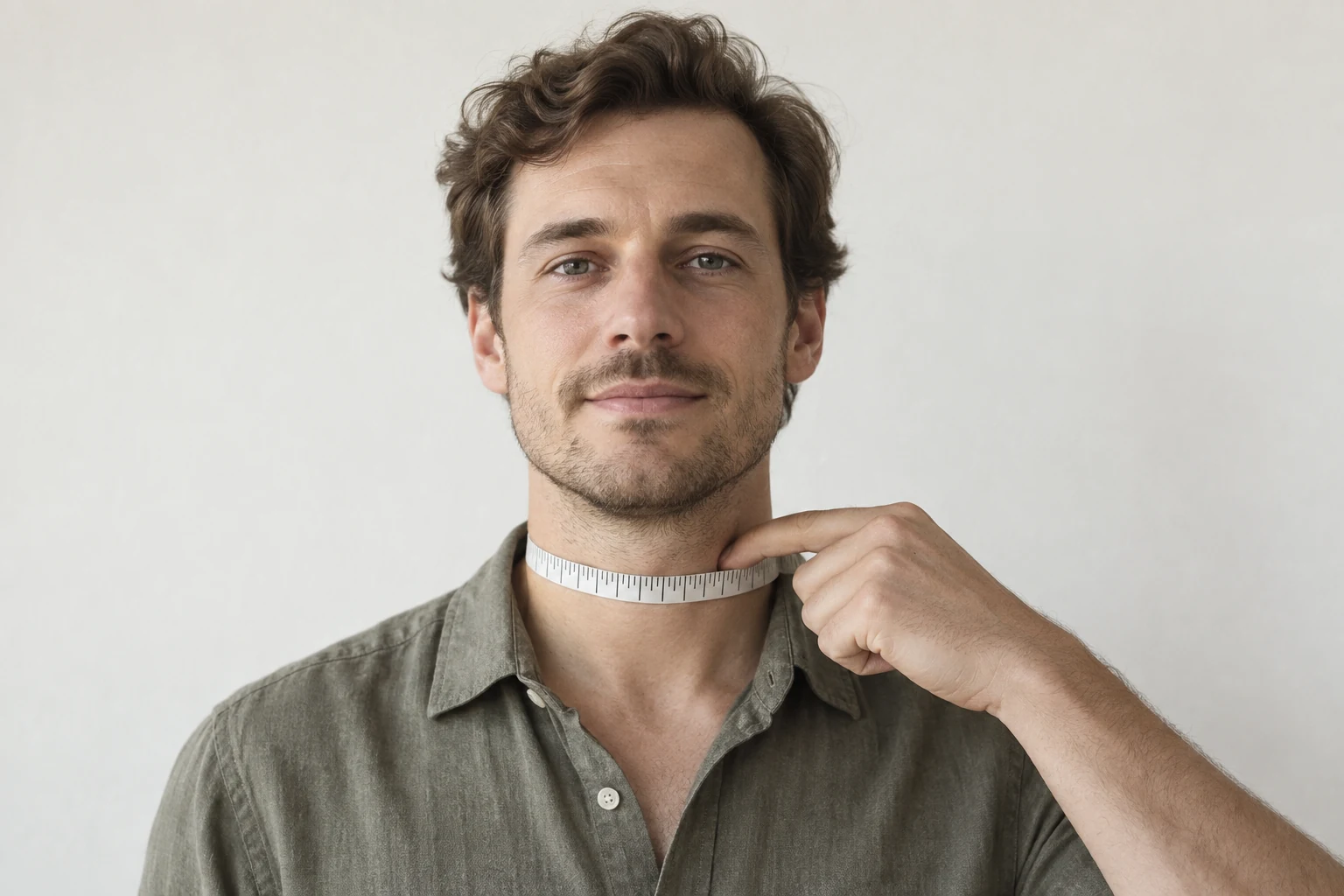
The neck measurement is where most sizing goes wrong, usually because the tape is too tight, too loose or in the wrong place. Stand straight and relaxed in front of a mirror, not wearing a shirt, and follow these steps.
Find where the collar sits
Place the tape around your neck at the height a shirt collar would rest, at the base of the neck and just below the Adam's apple. Proper Cloth and The Tie Bar both measure here. Too high on the neck and you will get a size too small.
Keep the tape level and relaxed
Check in the mirror that the tape is level all the way around, not dipping at the back. Look straight ahead without craning your neck or pressing your chin down, since both change the reading.
Allow a little room
Makers differ on this, so follow the method on the chart you are using. Proper Cloth asks you to hold one finger flat between the tape and your neck. The Tie Bar measures snugly and then adds half an inch. Both give roughly the same result: a collar that closes without pressing on your throat.
Round up to the half inch
Read the tape where it overlaps and round up to the nearest half inch. If you measure 15.3 inches with the finger allowance, your neck size is 15.5. Rounding down is how collars end up too tight under a tie.
How to measure your sleeve length
Shirt sleeve length is not measured from the shoulder seam, which surprises many people. It starts at the center of the back of your neck, so that shirts with different shoulder widths can share one number. This is much easier with a helper; if you are on your own, measure a shirt whose sleeves you already like instead, as described in the next section.
Stand with your arm relaxed
Let your arm hang naturally at your side, or bend it very slightly at the elbow, depending on the maker's instructions. A slight bend gives a little extra length so the cuff does not ride up when you reach.
Start at the center of the back of your neck
Your helper places the end of the tape at the bony point at the base of the back of your neck, the center point where a collar seam would sit.
Measure over the shoulder and down the arm
Run the tape across the top of the shoulder, down the outside of the arm and over the elbow to the wrist bone. Proper Cloth has you continue a little further, to the center of the palm, which is a reminder to follow the instructions that come with the chart you are ordering from.
Round to the nearest inch
For most men the result lands somewhere in the 30s, in inches. If you land between two lengths on a paired size, the pair covers you; between two single sizes, the longer one is usually easier, since a cuff that is slightly long can be held by the wrist while a short one cannot be fixed.
Check the numbers against a shirt you own
If you have a dress shirt that fits well, use it to confirm your measurements. Lay it flat with the collar unbuttoned and opened out, and measure from the center of the collar button to the far end of the buttonhole, which is the usual way to read a collar size from a shirt. Then put the shirt on, button the collar and slide your fingers in at the front of the neck. One or two flat fingers should fit without the collar pinching; if none fit, it is too small, and if the collar folds or sits away from your neck when the tie is knotted, it is too big.
To read the sleeve length from the same shirt, lay it face down and run the tape from the center of the collar seam at the back, along the shoulder seam and down the sleeve to the edge of the cuff. That single number is comparable with the sleeve size on a chart, and it needs no helper. On your body, the cuff should reach the point where your wrist meets your hand and just touch the base of the thumb with your arms at your sides. When you wear a jacket, that leaves a quarter to half an inch of cuff showing below the jacket sleeve, which is the effect our guide to how a suit should fit describes. For French cuffs, which fold back and close with cufflinks, the same length applies.
Slim, regular and classic fit
Neck and sleeve set the size; the fit sets the shape of the body. Many makers offer three or more cuts. Brooks Brothers, for example, describes its slim fit as cut closest to the chest and body with higher armholes, its regular fit as average through the chest, body and sleeves, and its traditional fit as the most relaxed. Names vary by maker, so a slim fit at one shop may match the regular at another, and it is worth comparing the chest and waist measurements on the chart rather than the name.
Choose the fit by how the shirt behaves when tucked in. It should lie flat across the chest without pulling at the buttons, and when you tuck in the shirt there should be a little extra fabric at the waist, but not enough to balloon over the waistband. If buttons strain across the chest, try a fuller cut in the same neck size before you go up a neck size.
Shrinkage, and what to do between sizes
Cotton shirts can shrink slightly in the first washes. The Tie Bar suggests allowing for 1 to 2 percent, while Proper Cloth tells customers not to add room because it builds shrinkage into its own patterns. That difference is why you should read the instructions on the specific chart you are using. Washing in cool water and taking shirts out of the dryer early, or hanging them to dry, keeps shrinkage small; our guide to ironing a shirt covers the rest.
If you are between neck sizes, go up. A tailor can take in the body of a shirt and shorten sleeves, but a collar that is too tight cannot be let out, and it is the one part of a dress shirt you feel all day. A tight collar also shows as soon as you knot a tie, pulling the points apart; if you are learning, our guide to tying a tie assumes a collar that closes comfortably.
Common mistakes
Measuring over a shirt
Measuring your neck over a collar adds fabric and gives a size too large. Measure against your skin and let the finger allowance or maker's rule provide the room.
Measuring the sleeve from the shoulder seam
Dress shirt sleeve sizes start at the center of the back of the neck. Measuring from the shoulder gives a number several inches too short.
Buying by letter size for a shirt you will wear with a tie
A medium covers more than one neck size, so the collar may not close properly when buttoned. Use the neck number for any shirt you plan to button to the top.
Questions people ask
What does 16 34/35 mean on a dress shirt?
It means a 16 inch neck and a sleeve cut to suit someone who measures 34 or 35 inches from the center of the back of the neck to the wrist. Paired sleeve sizes let makers cover more people with fewer sizes.
How do I measure my neck size without a tape measure?
Wrap a piece of string or a phone charger cable around your neck at the collar line, mark where it meets, and lay it along a ruler. Then add the finger allowance or half inch the maker recommends, and round up to the next half inch.
How tight should a dress shirt collar be?
When buttoned, you should be able to slide one or two fingers between the collar and your neck. It should close without pressing on your throat, and it should not gap or twist when you knot a tie.
Should I size up if I am between sizes?
For the neck, yes, because a tight collar cannot be let out. For the body, choose a fit that matches your chest and waist, since a tailor can take in extra fabric but cannot add it.
How do women's dress shirt sizes work?
Most women's shirts are sold in numeric dress sizes or letter sizes based on bust, waist and hip rather than neck and sleeve, so the chart to read is the maker's own. Measure your bust at the fullest point and compare it first, since that is where a button front shirt gapes. Our women's size chart guide explains how those numbers line up.
Sources and further reading
References used for this guide. Each opens the original page in a new tab.
Keep reading

Sizing
How to measure your waist and hips for clothes
Where your waist really is, how to measure your waist and hips accurately, how pants and jeans sizing differs, and how to read a size chart before you order.

Suits and tailoring
How a suit should fit: shoulders, sleeves and length
How should a suit fit? Check the shoulders, collar, button, jacket length, sleeves and trousers in the mirror, and learn which problems a tailor can and cannot fix.

Ties and knots
How to tie a tie: the easiest knot for beginners
Learn how to tie a tie with the four in hand, the easiest dependable knot: six steps from your own point of view, then length, dimple and which knot to try next.

Everyday style
How to tuck in a shirt so it stays put
How to tuck in a shirt so it lies flat and stays in all day: the standard tuck, the military tuck, shirt stays, and when to leave a shirt untucked.
Washing and ironing
How to iron a shirt in the right order
How to iron a shirt the way shirtmakers do: set the heat for the fabric, start slightly damp, then work collar, cuffs, sleeves, yoke, back and front in order.