How to measure ring size at home
In this guide
Ring size is a number most people never need until a checkout page asks for it, or until a surprise depends on getting it right without asking. Learning how to measure ring size at home is mostly about getting one small length right: the distance around your finger where the ring will sit, taken so that the ring can still pass the knuckle on its way there.
Fingers make that harder than it sounds. They are thinner on a cold morning than on a warm evening, the knuckle is usually wider than the base, and a wide band feels tighter than a narrow one in the same size. The methods below get you a reliable number, and the later sections explain how to adjust it for the finger and the ring you actually have.
Choose the most reliable method you have
The most accurate answer comes from a jeweler's finger gauge, a ring of metal bands that GIA describes as stepping up in half sizes. You slide them on until one passes the knuckle and sits comfortably, which tests the real problem rather than a paper model of it. Many online jewelers, Blue Nile among them, will send a plastic sizer that works the same way, and it is worth the wait if you are buying something expensive.
If you need a number tonight, a ring that already fits the same finger is the next best thing, because it is a rigid object with a fixed size. A strip of paper wrapped around the finger comes after that. A narrow flexible sewing tape can stand in for the paper, read directly in millimeters, as long as it lies flat around the finger rather than folding at the edges. String comes last: GIA points out that string stretches under tension and paper can curl or shift with humidity, and neither tells you whether the ring will clear your knuckle. Printable and on screen charts only work at true scale, so check them against a ruler first; a screen that zooms or a printer set to fit the page will quietly change every circle.
How to measure ring size at home with paper
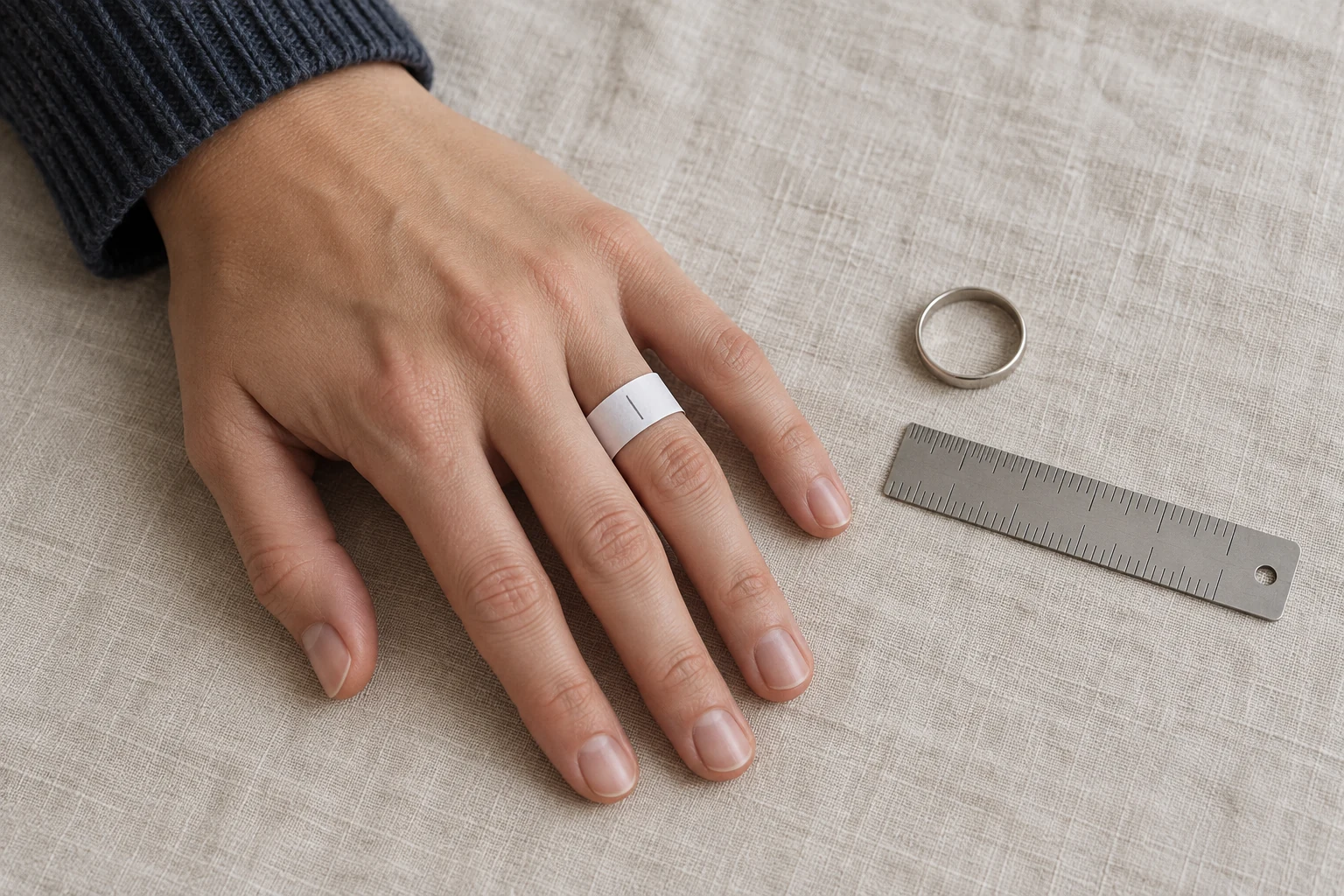
Use a strip of plain paper about as wide as the ring you plan to wear, no wider than a quarter inch (about 6 mm), a fine pen and a ruler marked in millimeters. Do this in a warm room, late in the day, when your hands are neither cold nor swollen from exercise. Treat it like any body measurement: one reading is a guess, two that agree are a number.
Wrap the base of the finger
Wind the strip once around the base of the finger that will wear the ring, where the ring will actually rest. Keep it flat, not twisted, and snug enough that it does not slide, without pressing into the skin.
Mark the overlap
Draw a fine line where the end of the paper meets the strip underneath. A thick marker line can hide a millimeter, which is close to half a size, so use a sharp pen.
Test the knuckle
Before you unwrap, hold the overlap with a small piece of tape and slide the loop toward the fingertip. If it will not pass the knuckle, loosen it until it just does and mark again; a ring that fits the base but not the knuckle is a ring you cannot put on.
Measure and repeat
Unroll the strip and measure from the end to your mark in millimeters. This is the circumference of your finger. Take it at least twice, ideally on different days, and use the larger result if they disagree slightly.
Measure a ring you already own
Choose a ring that fits comfortably on the same finger of the same hand. GIA notes that for most people the dominant hand is about half a size larger than the other, so a ring from your right ring finger may be loose on your left. A ring from a middle finger, index finger or thumb will be a different size altogether.
Lay the ring flat on a ruler and measure the inside diameter at its widest point, from inner edge to inner edge, in millimeters. Alternatively, set it on a correctly printed sizing chart and find the circle whose outline sits just inside the ring's inner edge. Measuring the inside matters: the thickness of the band has nothing to do with the finger. If you want the circumference instead, multiply the diameter by 3.14. You can also take the ring to any jeweler, who can read it on a sizing mandrel in seconds.
Read a ring size chart in millimeters
In the United States and Canada, ring sizes run in quarter steps, and each whole size adds about 2.5 mm to the inside circumference, or about 0.8 mm to the diameter. On GIA's chart a US 5 is about 49.3 mm around (15.7 mm across), a 6 is 51.8 mm (16.5 mm), a 7 is 54.3 mm (17.3 mm), an 8 is 56.9 mm (18.1 mm), a 9 is 59.7 mm (19.0 mm) and a 10 is 62.2 mm (19.8 mm). A quarter size is therefore only about 0.6 mm of circumference, which is why a careful mark matters.
To convert a circumference yourself, subtract 36.5 from the millimeters and divide by 2.55. The result is your approximate US size, so a 6 cm finger, 60 mm around, comes out just over a US 9. Much of continental Europe uses the ISO system, where the size is simply the inside circumference in millimeters, so a European 52 is close to a US 6 and a 57 close to a US 8. The UK, Ireland and Australia use letters that step by 1.25 mm and do not line up neatly with US quarter sizes, so read the conversion from the seller's own chart.
Blue Nile reports that its most popular women's size is 6, with most women's purchases between 5 and 7, and its most popular men's size is 9, with most men's purchases between 8 and 10 1/2. Those figures are useful only as a sanity check. If your measurement lands far outside them, measure again, but do not round yourself toward the average.
| US size | Inside circumference | Inside diameter |
|---|---|---|
| 5 | About 49.3 mm | About 15.7 mm |
| 6 | About 51.8 mm | About 16.5 mm |
| 7 | About 54.3 mm | About 17.3 mm |
| 8 | About 56.9 mm | About 18.1 mm |
| 9 | About 59.7 mm | About 19.0 mm |
| 10 | About 62.2 mm | About 19.8 mm |
In the ISO system used in much of continental Europe, the size is simply the inside circumference in millimeters.
Allow for knuckles, temperature and wide bands
Fingers shrink in the cold and swell in heat, and GIA adds that humidity, altitude, season and time of day all shift them. That is why Blue Nile suggests measuring at the end of the day, when fingers are warm and slightly larger, and measuring more than once. A ring sized on a chilly morning can feel tight on a summer evening, while one sized on a hot day may slip off in winter. Feet behave the same way, which is why shoe fitting advice also favors the end of the day.
Knuckles are the other variable. If yours are noticeably wider than the base of the finger, a ring that sits perfectly at the base may not go on, and one that passes the knuckle easily may spin. Blue Nile's advice is to choose a size between the two measurements, one that goes over the knuckle with a little pressure and then settles without sliding around.
Width changes fit too. A wide band covers more skin and feels snugger than a narrow one in the same size. GIA suggests talking to a jeweler once the width reaches about 4 to 5 mm, including an engagement ring and band worn together, and Blue Nile suggests going up about half a size for wide styles. Several thin rings stacked on one finger can behave much like a single wide band, so size a stack the same way.
Choose between two sizes and plan for resizing
When your measurement falls between two sizes, Blue Nile recommends the larger one, and GIA gives a practical reason: making a ring smaller is generally easier for a jeweler than making it bigger. A slightly loose ring can be taken in; a tight one may need metal added or may not be adjustable at all.
Some designs cannot be resized easily, which makes measuring well more important. GIA lists pavé and channel set bands, eternity rings with stones all the way around, and twisted bands among the difficult ones. If you are buying one of these, use a jeweler's gauge or a plastic sizer rather than paper, and check the seller's resizing and return terms before you order.
Check the fit when the ring arrives
A ring that fits should slide over the knuckle with slight resistance, then sit at the base without spinning freely or leaving a deep dent. Wear it for a full day before deciding, through a warm afternoon and a cool evening, and try shaking your hand gently over a bed to be sure it will not fly off. If it pinches only when your hands are hot, it is probably right for the rest of the year; if it pinches all the time, go up a quarter or half size. Once it has settled in, our guide to cleaning silver jewelry will help keep a sterling band bright. Between wears, keeping it in its own compartment, as our guide to storing jewelry suggests, stops harder stones from scratching a soft metal band.
Common mistakes
Measuring with string
String stretches while it is wrapped and relaxes when you lay it flat, which can make the result read smaller than your finger. Paper that is kept flat is steadier, and a ring you already own is steadier still.
Measuring cold hands first thing in the morning
Cold fingers can measure a size smaller than warm ones. Measure in a warm room later in the day, and repeat on another day before you order anything that is hard to resize.
Borrowing a ring from the wrong finger
A ring worn on the right hand or on another finger will not match the left ring finger. If you are sizing someone secretly, pick a ring they wear on the same finger, or ask a jeweler to read it for you.
Trusting an on screen chart without checking scale
Phone and laptop screens display sizing circles at different real sizes. Unless the page asks you to calibrate it against a card or ruler and you do so, treat the result as a rough guess.
Questions people ask
What ring size is 6 cm?
A finger that measures 60 mm around is just over a US size 9, which GIA lists at about 59.7 mm, and a little under a 9 1/4 at about 60.3 mm. In the European ISO system the same finger is a size 60, because that system uses the circumference in millimeters. If you measured 6 cm across the inside of a ring rather than around a finger, that is a diameter, and you should compare it with the diameter column instead.
How big is a size 7 ring in inches?
On GIA's chart a US size 7 measures about 54.3 mm around the inside, which is about 2.14 inches, and about 17.3 mm, or 0.68 inch, across. A size 9 is about 59.7 mm around, roughly 2.35 inches, with an inside diameter of about 19 mm, or 0.75 inch. Because a quarter size is well under a millimeter of diameter, measure in millimeters when you can and convert afterward.
Are ring sizer apps accurate?
Apps that ask you to place an existing ring on the screen can be close if they calibrate your screen to a real object first, such as a card. Apps that estimate a finger from a photo are much less dependable, because they cannot feel the knuckle or the snugness. Use an app as a first estimate, then confirm with a physical ring or sizer.
Is my ring size the same on both hands?
Usually not quite. GIA notes that the ring finger on the dominant hand tends to be about half a size larger. Measure the exact finger that will wear the ring.
Can my ring size change over time?
Yes. Weight change, pregnancy, heat, and changes to the joints can all alter how a ring fits, and fingers vary with the seasons. If a ring that used to fit starts to pinch or slide, measure again rather than relying on the size you were given years ago.
Sources and further reading
References used for this guide. Each opens the original page in a new tab.
Keep reading
Shoes and jewelry
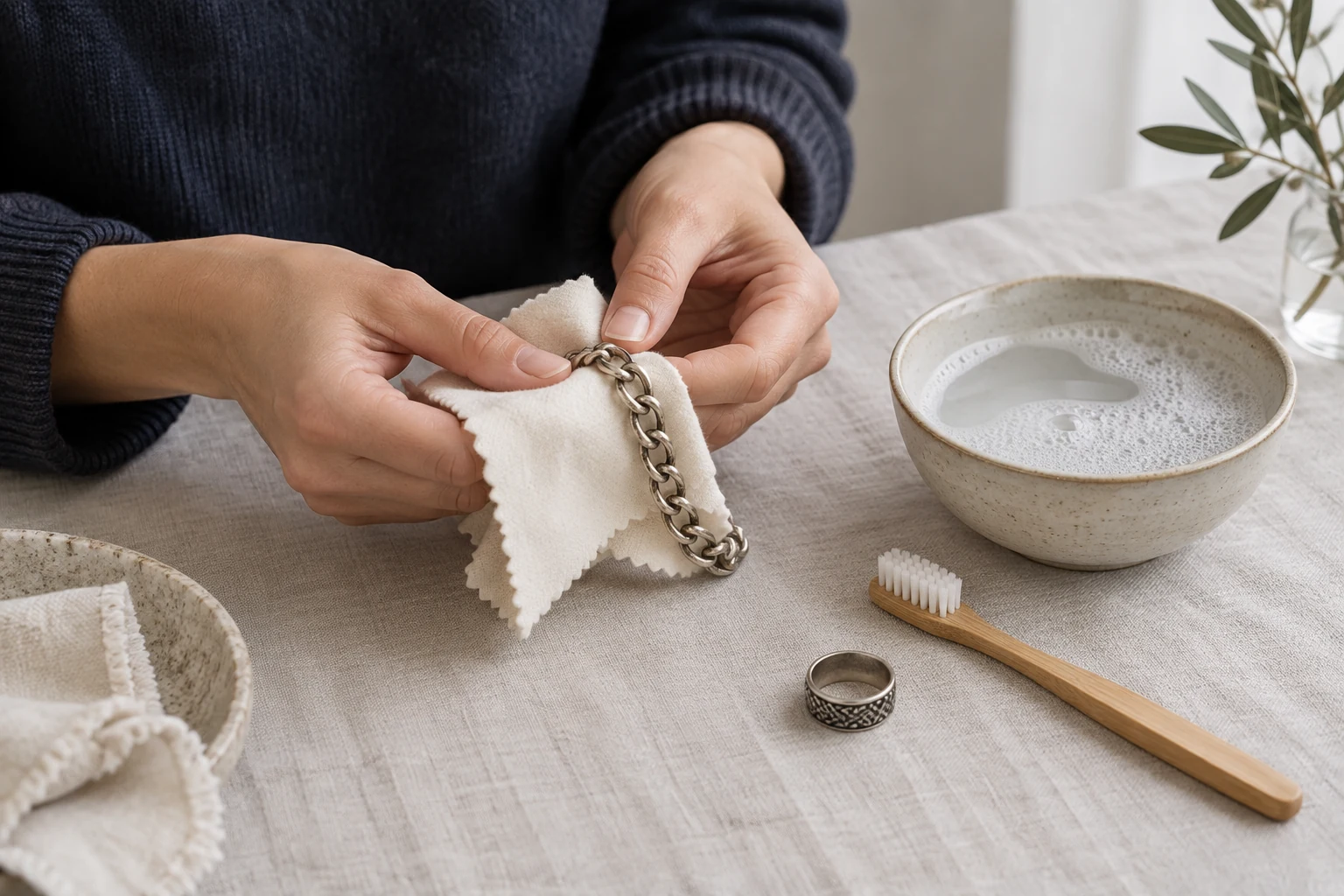
How to clean silver jewelry at home, gently
How to clean silver jewelry at home, gentlest method first, with care for pearls, stones and plated pieces, a short gold section, and simple ways to prevent tarnish.
Closet and packing
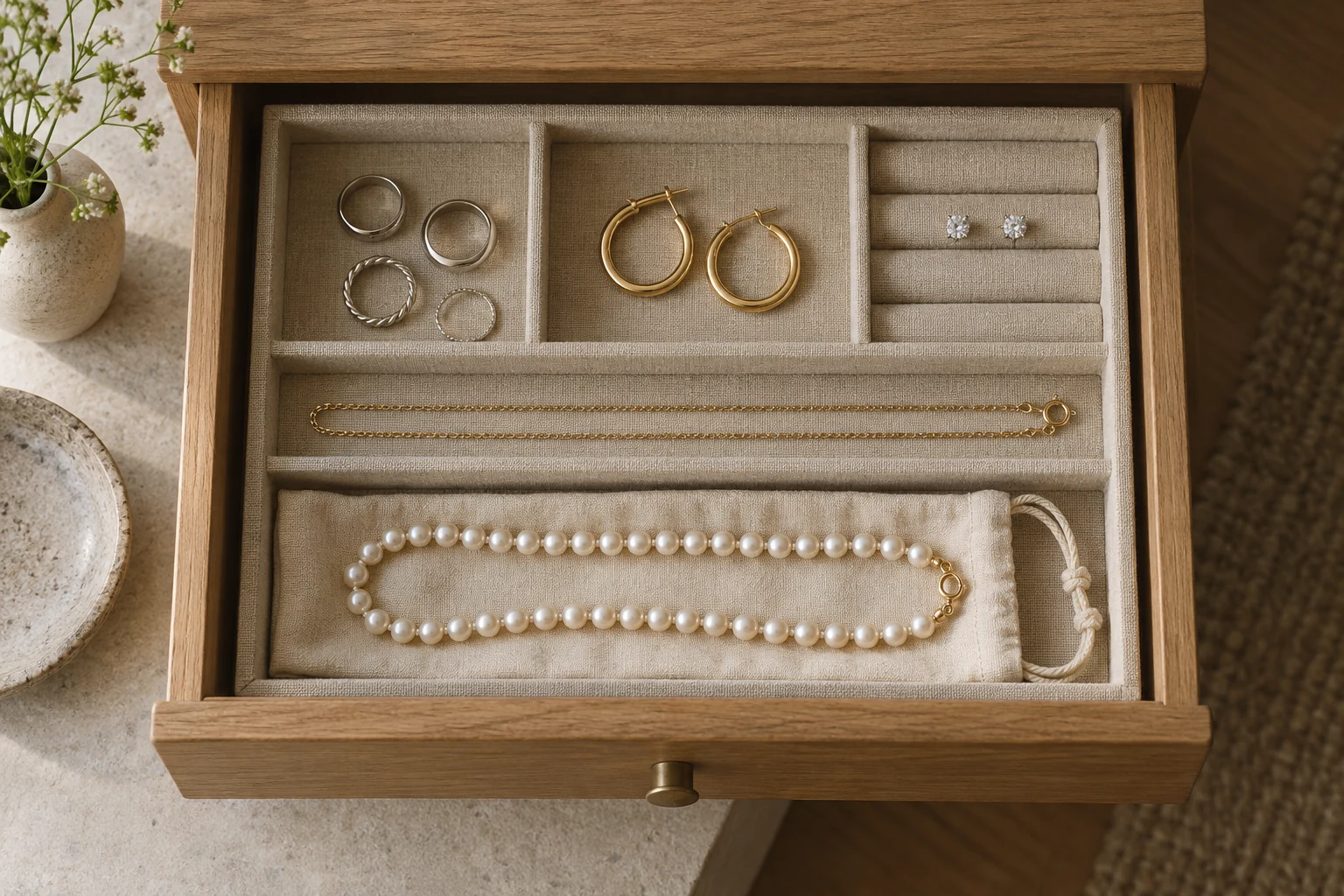
How to store jewelry without tangles or tarnish
How to store jewelry at home and on the road: keep silver from tarnishing, pearls from drying out, chains from tangling and diamonds from scratching everything else.
Sizing
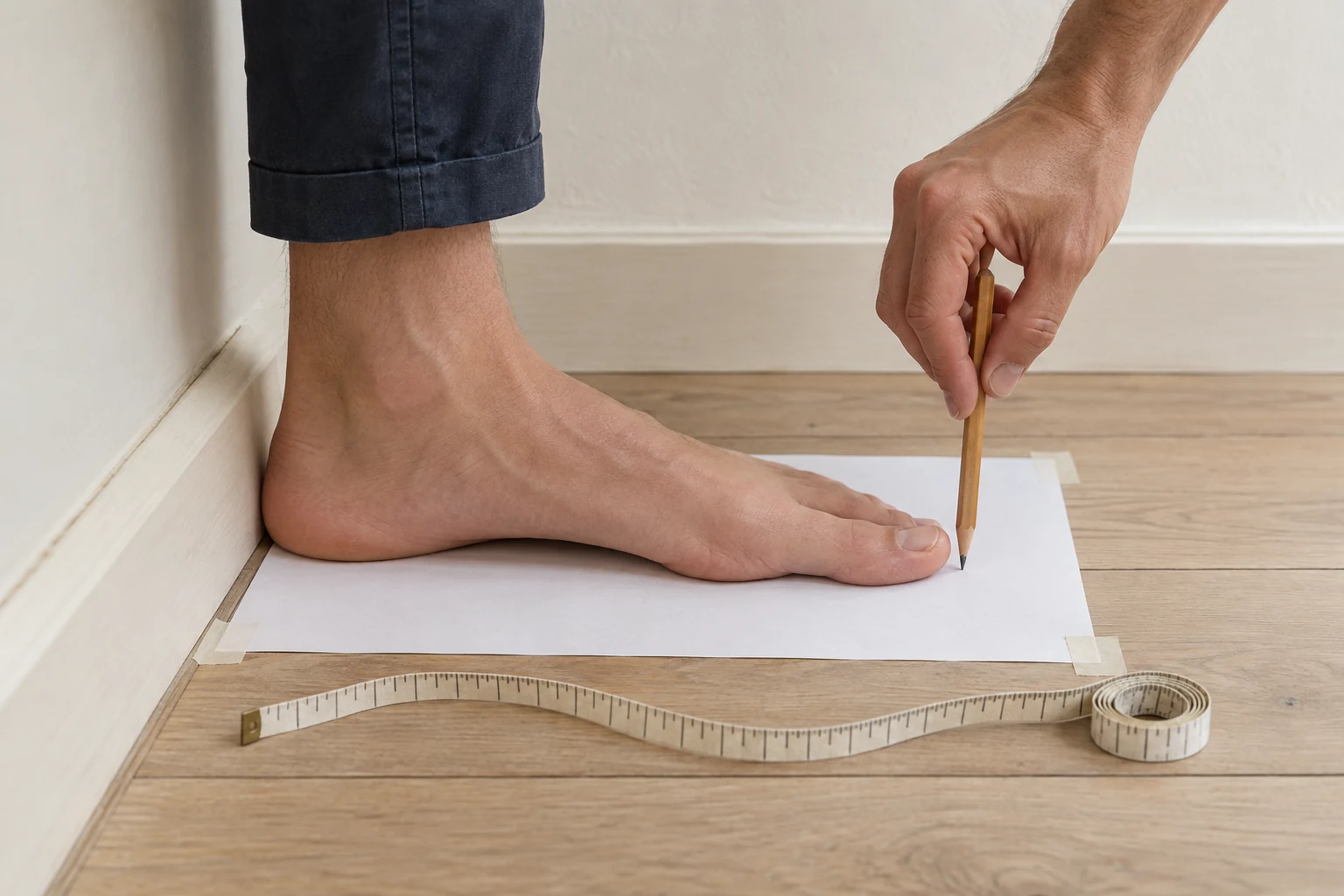
Shoe size conversion: US, UK and EU for men and women
Convert shoe sizes between US men's and women's, UK and EU, see why conversion charts disagree, and measure your foot so you can pick the right size in any brand.
Sizing
Hat size chart: how to measure your head for any hat
Measure your head for a hat at home, read a hat size chart in inches and centimeters, and choose sizes for fitted caps, snapbacks, cowboy hats and knitted hats.
Everyday style
How to layer necklaces without tangling
How to layer necklaces so they sit apart and stay untangled: choosing lengths, spacing them 2 inches apart, mixing gold and silver, and using layering clasps.