How to hold a wine glass, and other small table habits
In this guide
Someone hands you a glass of wine at a dinner party, and suddenly you are aware of your own hand. Should it be on the stem? The bowl? Is everyone watching? Knowing how to hold a wine glass takes about ten seconds to learn, and the reasons behind it are practical rather than snobbish, which makes the habit easy to keep.
This guide covers the stem grip and why it exists, how it changes for red, white, sparkling and stemless glasses, how to take part in a toast, and the other small habit people often wonder about at the same table: how to hold a fork and knife, the difference between the American and Continental styles, and where to leave them when you pause or finish. The conventions described here are those of the Emily Post Institute, the usual American reference, with notes where European custom differs.
How to hold a wine glass by the stem
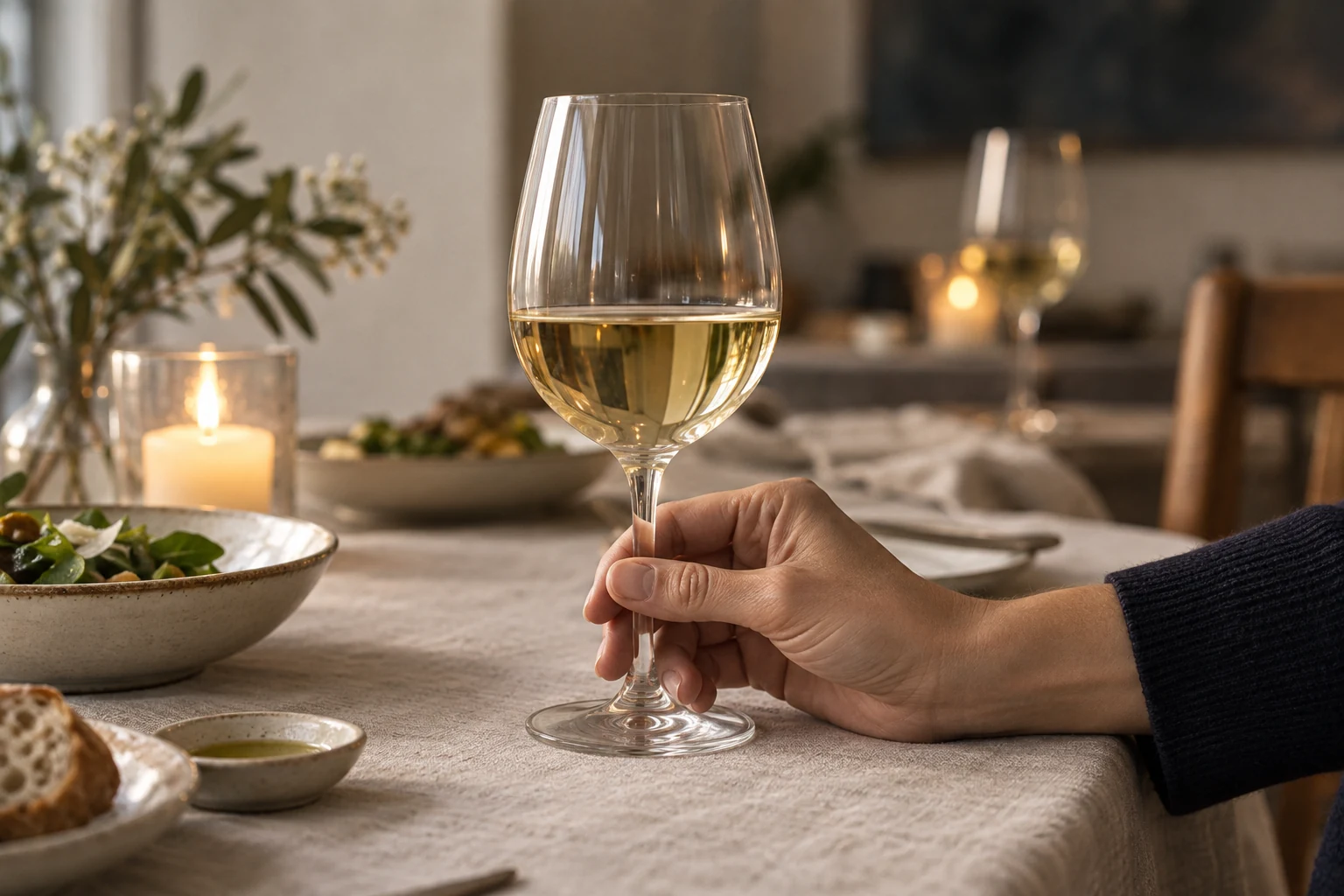
The correct way to hold a wine glass is by the stem. Pinch it between your thumb and your index and middle fingers, a little below the middle of the stem, and let your ring and little fingers rest lightly against the stem or on the foot for balance. Your hand should feel relaxed, and the glass should sit steady enough that you could walk across a room with it. Some people who taste wine for a living hold the foot itself, pinching the flat base between thumb and forefinger; it is steady on a table but harder to manage while standing and talking. If the stem is short, as on many everyday or restaurant glasses, hold it right up under the bowl with your fingertips and let the foot rest against your little finger; a brief touch of the bowl is better than a wobbly grip.
The reasons are simple. Dr. Vinny, the wine advice columnist at Wine Spectator, gives two: holding the stem keeps the warmth of your hand from warming the wine, and it keeps fingerprints off the bowl. A clean bowl also lets you see the color of the wine and swirl it without smudging the glass, which is part of the pleasure for people who enjoy looking at what they drink.
The same column is clear about the limits of the rule. Stability and comfort come first, and someone with arthritis or a weak grip should hold the glass by the bowl, or with two hands, without a second thought. A spilled glass is a far bigger disruption than an unconventional grip. If a glass of red does end up on your sleeve, our guide to getting red wine out of clothes explains what to do before the stain sets.
Red, white, champagne, stemless and cocktail glasses
White, rosé and sparkling wines are served chilled, so the stem matters most with them: a warm palm wrapped around the bowl makes a difference within minutes. To hold a champagne glass, whether a flute or a coupe, take the stem the same way and keep your hand well below the bowl. Flutes are tall and top heavy, so a slightly lower grip on the stem is steadier.
To hold a red wine glass, use the stem too, though the large bowl invites your hand. Because red wine is served warmer, cupping the bowl for a moment does less harm, and some people do it deliberately when a red has been served too cold. That is the same principle in reverse: your hand warms the wine, so you choose when to let it.
Stemless glasses have no stem to use, so hold them low, near the base, with your fingertips rather than your whole palm. You will leave some prints; that is the trade off of the design. For a cocktail glass with a stem, such as a martini glass or a coupe, the stem grip is not only polite but practical, because a wide, shallow bowl spills easily and the drink is meant to stay cold. Tumblers and rocks glasses are simply held around the lower half.
| Glass | Where to hold it | Why |
|---|---|---|
| White, rosé or sparkling | The stem, hand well below the bowl | The wine is served chilled and a palm warms it within minutes |
| Champagne flute or coupe | The stem, a little lower on a flute | Flutes are tall and top heavy |
| Red wine glass | The stem; a brief cup of the bowl is fine | Red is served warmer, and hand warmth can help a cold red |
| Stemless glass | Low near the base with fingertips | No stem, so some prints are the trade off |
| Martini glass or coupe | The stem | A wide shallow bowl spills easily and the drink should stay cold |
| Tumbler or rocks glass | Around the lower half | No stem to use |
How to toast without fuss
Emily Post's guidance on toasting is reassuringly short. At a dinner party, the host usually offers the first toast; if the host does not, a guest may propose one to the hosts, and among friends that often happens first anyway. Toasts tend to come when the drinks are first poured or just before dessert. The person giving the toast stands, except at a small, informal table, and everyone else stays seated unless asked to rise. At weddings, toasts are longer and more structured, and our guide on what to wear to a wedding covers the rest of that evening's etiquette.
When the toast ends, everyone raises a glass and drinks, except the person being honored, who does not drink to themselves but smiles, nods or says thank you. A sip is enough; nobody needs to drain the glass. You do not need an alcoholic drink either, and water or anything else in your glass is perfectly fine to raise.
Clinking glasses is optional. At a small table it is friendly to touch glasses with your neighbors, bowl to bowl rather than rim to rim, since the rim is the thinnest and most fragile part of most glasses. At a long table, raising your glass and meeting people's eyes is better than reaching across plates. To get a room's attention, stand and wait for a pause rather than tapping a glass with a knife, which risks chipping it.
How to hold a fork and knife
Fork and knife etiquette starts with the grip. Emily Post advises against gripping a fork in your fist or using it like a shovel. When cutting, hold the fork and knife with the handles in your palms and use your thumb, index and middle fingers to hold each one near the neck, where the handle meets the head. Your index finger can rest along the back of the knife to guide the cut. This gives the most control, which is also why it looks tidy.
When you use the fork or spoon alone, the grip changes to something closer to holding a pencil: the handle rests in the web between your thumb and index finger, with your middle finger underneath and the thumb and index finger holding it from either side. Cut one or two bites at a time rather than the whole plate at once.
As for which hand, in both the American and Continental styles the fork starts in the left hand and the knife in the right while cutting. Table settings are laid out for right handed diners, so many left handed people simply swap hands, and that is entirely acceptable. For a fuller guide to what sits where before the meal begins, see our guide to table etiquette and place settings.
American and Continental style, side by side
In the American style, you cut a bite with the fork in your left hand, tines down, and the knife in your right. Then you set the knife on the plate, move the fork to your right hand, turn it tines up and eat. Emily Post notes this is sometimes called the zigzag style, because the fork travels back and forth between hands through the meal.
In the Continental style, used across much of Europe, the fork stays in your left hand with the tines pointing down the whole time, and the same grip carries the food to your mouth. The knife stays in your right hand and helps push food onto the back of the fork. Emily Post observes that many Americans find this simpler, and that it is perfectly fine in the United States to use either style, or even to switch between them during the same course. Neither is more correct than the other; the point is to eat neatly without drawing attention to your hands.
Fork and knife placement when you pause and when you finish
Where you leave your cutlery quietly tells the server whether you are still eating. For the finished position, Emily Post says to picture the plate as a clock face and lay the fork and knife side by side with both handles resting at about four o'clock, then leave the plate where it is rather than pushing it away. Once you have used a piece of cutlery, rest it on the plate rather than back on the tablecloth.
To pause, separate them. The Italian cutlery maker Sambonet describes the pause position as the fork at about seven o'clock and the knife at about four o'clock, blade facing in, so the two form an open V on the plate. European conventions for the finished position vary more than people expect: Sambonet notes an English habit of placing the cutlery at about half past six and a French one at about twenty past four. If you are abroad or the server hovers uncertainly, a quiet word works better than any code. For how cutlery and glasses are laid for a longer meal, see our guide to the formal table setting.
Common mistakes
Gripping the bowl of a chilled wine
A full hand around the bowl of a white or sparkling wine warms it within minutes and leaves prints on the glass. Move your hand to the stem, unless comfort or a weak grip means the bowl is safer.
Reaching across the table to clink
Stretching over plates to touch every glass risks spills. Clink with your neighbors and raise your glass to everyone else.
Pushing your plate away when you finish
It crowds the table and your neighbor. Lay your fork and knife together on the plate instead, and let the server clear it.
Questions people ask
Is it rude to hold a wine glass by the bowl?
It is not rude, just less practical with chilled wine because your hand warms it and marks the glass. Wine Spectator's Dr. Vinny is clear that people who find the stem difficult should hold the glass however is steadiest. Nobody at a well mannered table will mind.
How do you hold a champagne flute?
Hold it by the stem, between your thumb and first two fingers, a little lower than you would a wine glass because a flute is tall and top heavy. Keep your hand off the bowl so the champagne stays cold.
Is there a different way for women to hold a wine glass?
No. The stem grip is the same for everyone, and it looks elegant on anyone because the hand stays relaxed and the glass stays upright. A raised little finger is a mannerism rather than etiquette, and most guides treat it as fussy. In Italy, France and elsewhere in Europe the stem grip is the norm too, and eye contact during a toast matters more than any detail of the hand.
Is it rude to switch the fork to your right hand?
No. Switching hands after cutting is the traditional American style, and Emily Post considers both it and the Continental style correct in the United States. You can even use both during the same meal.
Where should I put my wine glass between sips?
Set it back in its place on the right, above your knife, where it was when you sat down. Keeping drinks on the right and bread on the left stops neighbors from picking up the wrong glass at a crowded table. Holding a glass through a whole conversation is fine at a standing reception, but at the table it is steadier on the cloth.
Should wine glasses be stored upside down or right side up?
Right side up is the safer habit for most stemware, because the rim is the thinnest part of the glass and standing it on the rim invites chips. Glasses stored upside down on a shelf can also pick up a stale smell from the shelf. If dust is the worry, give them a quick rinse or polish before guests arrive.
Sources and further reading
References used for this guide. Each opens the original page in a new tab.
- Wine Spectator, Ask Dr. Vinny: Is it OK to hold a wineglass by the bowl? Opens in a new tab
- Emily Post Institute: All about toasting Opens in a new tab
- Emily Post Institute: Top table manners tips, including how to hold utensils Opens in a new tab
- Emily Post Institute: Table manners, Continental style dining Opens in a new tab
- Emily Post Institute: Top questions for dining out, including the finished position Opens in a new tab
- Sambonet: How to place cutlery during and at the end of a meal Opens in a new tab
Keep reading
At the table
How to set a table: the basic place setting
How to set a table for everyday meals and for dinner: where the plate, fork, knife, spoon, glass and napkin go, and how to read a setting as a guest.
At the table
Formal table setting: how to set a formal dinner table
How to set a formal table: cutlery from the outside in, glasses in order of use, the bread plate, dessert cutlery and place cards, following Emily Post.

Stain removal
How to get red wine out of clothes
Get red wine out of clothes by blotting and flushing with cool water, then treating what is left with detergent and oxygen bleach, even once it has dried.
Dress codes
Wedding guest attire: every dress code decoded
Wedding guest attire explained from black tie to casual, with what men and women can wear for each dress code, plus color, venue and religious considerations.
Dress codes
Cocktail attire for women: what to wear
What cocktail attire means for women: dress lengths, fabrics, jumpsuits and tailored sets, shoes and bags, and how the invitation, venue and season change it.