How to tie a trinity knot, step by step
In this guide
A trinity knot tie looks like a small puzzle at the collar: three rounded sections that seem to fold into one another, with no single smooth face like an ordinary knot. It usually catches the eye at a wedding or a party, and then the question is how anyone ties that before a mirror in the morning. It takes patience and a different way of working: the wide end never moves, and the narrow end does all the wrapping.
This guide gives the eleven moves from your own point of view, with a checkpoint after each one, then explains which ties cooperate, where the knot looks right and where it reads as too much. If you have never tied a standard knot, learn a four in hand knot first. The trinity assumes you already know what a neck loop is and how a tie behaves when you pull it.
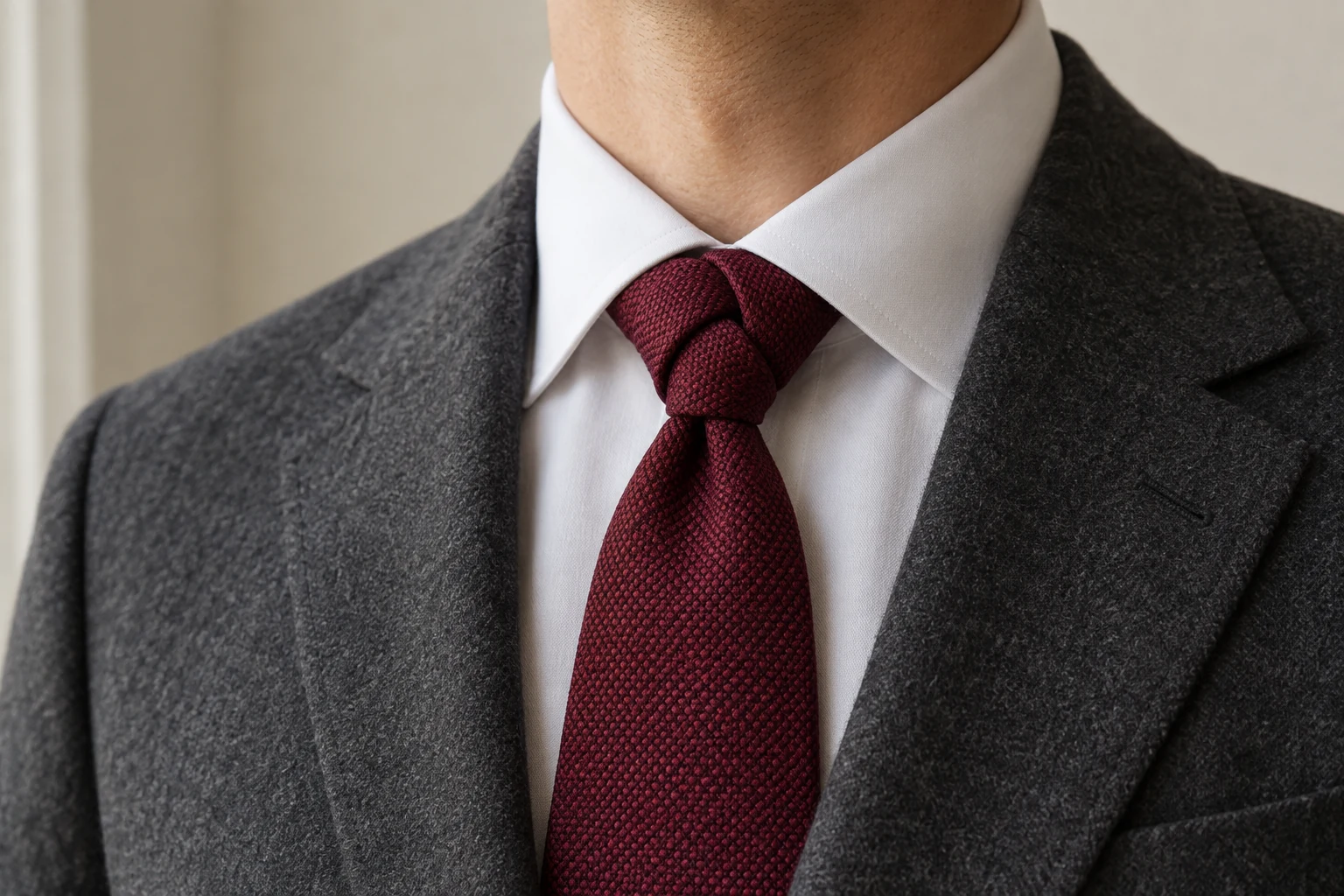
What the trinity knot is, and what the name means
The trinity is a recent knot, spread mostly through online tutorials rather than tailoring tradition. Ties.com calls it a relatively new innovation and describes the result as rounded, slightly asymmetrical and a little larger than a Windsor. Its name comes from the finished shape: three interlocking lobes that resemble the Celtic triquetra, the three cornered knot pattern also called the trinity knot, which some Christians read as a symbol of the Holy Trinity. The tie has no fixed meaning beyond that resemblance. Wearing it says you enjoy a decorative knot, not that you belong to any faith or group.
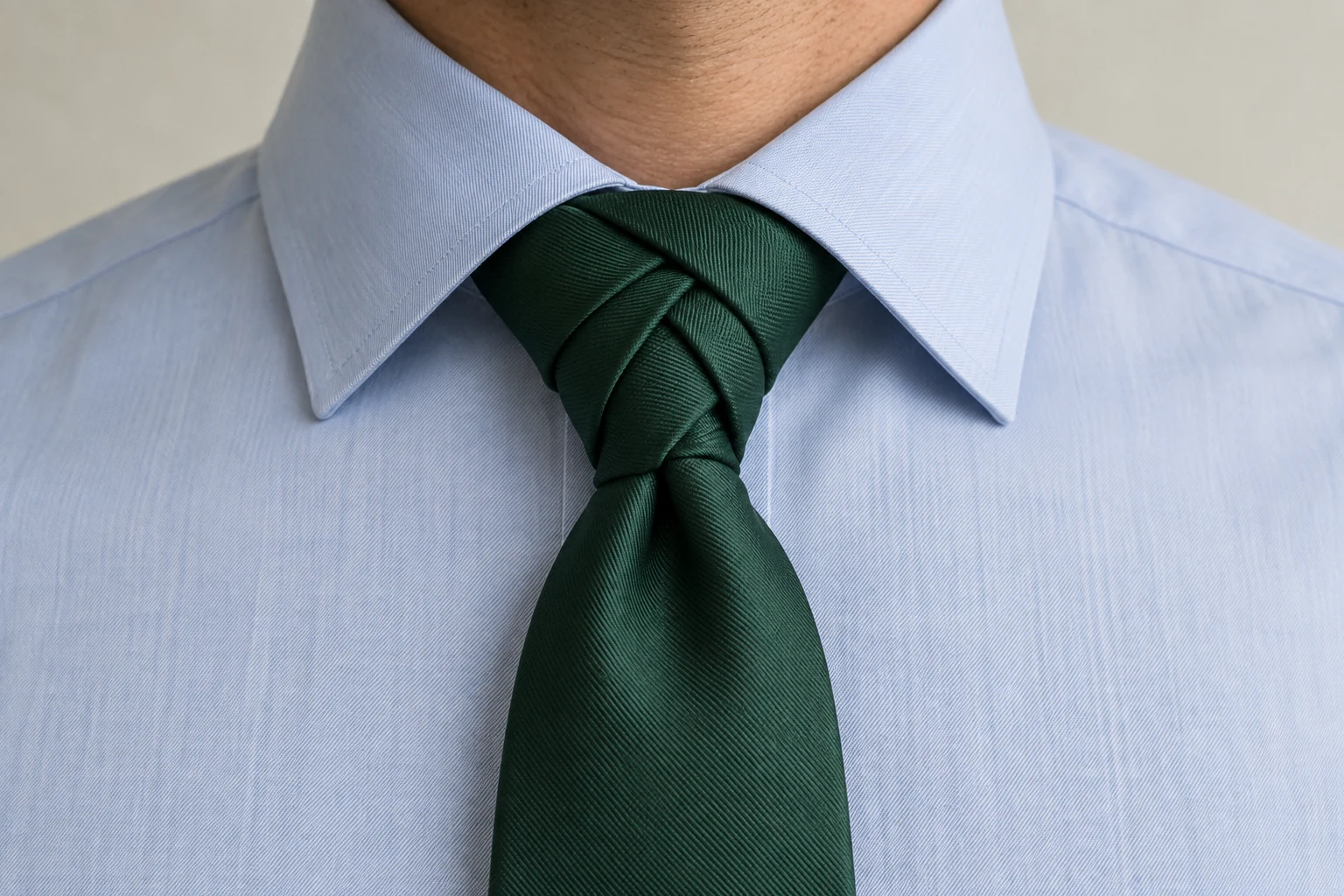
Mechanically it belongs to the same family as the Eldredge knot: both are tail knots, tied with the narrow end around a wide end that stays at its final length. The Eldredge ends with braided diagonal bands that climb the knot; the trinity ends with three folded sections around a center. Both use a lot of the narrow end and both hide the leftover tail behind the collar. If you have tied one, the other will feel familiar within a few tries.
Choose a tie that shows the shape
Because the knot itself is the decoration, a solid or finely textured tie shows it best. OTAA recommends solid colors and advises against bold prints, and that matches what you will see in the mirror: stripes run in different directions across each lobe and turn the knot into visual noise. A grenadine, a fine twill or a plain satin silk shows each fold clearly. Light to medium weight silk folds cleanly; a thick wool or heavily lined tie makes each lobe fat, and the knot grows too large for most collars.
Length matters more than with a front knot. Every wrap is paid for by the narrow end, so a standard tie of about 57 to 58 inches (145 to 147 cm) suits a man of average height and neck, while taller men or larger necks usually need an extra long tie. Our guide to tie length explains the sizes. Pair the knot with a spread or semi spread collar that gives the wide shape room; a narrow point collar or a button down squeezes it. The differences are laid out in our guide to types of shirt collars.
Set the wide end first, then leave it alone
Fasten the top button and turn your collar up. Drape the tie with the seam against your shirt, the wide end on your left and the narrow end on your right. Now set the wide end where it will finish: its tip at the middle of your belt buckle. Tie a Tie describes the same start with the narrow end hanging well below the wide end, which is correct here and the reverse of a normal knot. Almost all the spare length sits on the narrow side.
In every step, left and right mean your own hands. The neck loop is the band of tie around your collar, the crossing is the point just below your chin where the ends meet, and the front band is a horizontal strip you lay across the knot. Keep your left hand lightly on the wide end at the crossing whenever you can, so the wraps do not drag it upward. Work in front of a mirror but trust your own body for direction, since the reflection reverses left and right.
How to tie a trinity knot
Take the moves slowly and stop at each checkpoint. If what you see does not match, undo back to the last step that did rather than pushing on, because a wrong wrap in the middle cannot be fixed at the end.
Cross the narrow end over to your left
Bring the narrow end from your right across the front of the wide end to your left, just below the collar.
CheckThe narrow end lies over the wide end and points to your left.
Up through the neck loop from underneath
Pass the narrow end behind the crossing, between the tie and your shirt, and bring it up and out through the top of the neck loop.
CheckThe narrow tip points up toward your chin.
Down to your left
Fold the narrow end down over the front toward your left and pull it snug.
CheckThe narrow end hangs on your left, and the first diagonal fold lies over the left side of the crossing. This is the first lobe.
Behind the wide end to your right
Take the narrow end behind the wide end, from your left to your right.
CheckThe narrow end hangs on your right, and nothing new shows on the front.
Up in front and down through the neck loop to your left
Bring the narrow end up in front of the crossing to the center of your collar, pass it over the neck loop and down through it, and draw it out on your left.
CheckThe narrow end is on your left, and a second diagonal fold now rises from the lower right to the collar. Two lobes are visible.
Across the front to your right
Carry the narrow end horizontally across the front of the knot, from your left to your right.
CheckA flat front band runs across the lower part of the knot. Keep a fingertip under it so it stays open.
Up through the neck loop again
Pass the narrow end behind the knot and bring it up and out through the neck loop from underneath.
CheckThe narrow tip points at your chin again, with the front band still open below.
Down through the front band, loosely
Feed the narrow end down through the front band you held open, and do not tighten it. Leave a small loose loop at the center of the knot.
CheckThe narrow end hangs down in front of the wide blade, and a soft loop sits in the middle of the knot.
Behind the wide end to your right
Take the narrow end around behind the wide blade and bring it out on your right.
CheckThe narrow end is on your right, and the loose center loop is still open.
Across and through the loose loop
Carry the narrow end across the front toward your left and pass it through the loose loop from step eight. Pull it gently toward your left to close the loop.
CheckThree rounded lobes surround a center, and the knot holds without your hands.
Tuck the tail and settle the knot
Tuck what remains of the narrow end behind the neck loop on your left so it disappears under the collar. Fold the collar down, then ease each lobe with your fingertips until they look balanced.
CheckThe wide tip is still at your belt buckle, and no narrow end shows.
Fix the usual trinity knot problems
If you run out of narrow end before the tuck, the wide end started too low or the tie is too short for this knot. You cannot borrow length from the wide end without changing where it finishes, so raise the wide tip half an inch to an inch (1 to 2.5 cm) and start again, or switch to a longer tie. If the wide tip has crept above your belt by the end, the wraps pulled it up; keep your left hand on it at the crossing and tighten with smaller pulls.
Uneven lobes are normal for the first several attempts, and Ties.com rates the knot low for symmetry for good reason. Loosen the knot slightly, slide each fold with a fingertip until the two outer lobes match, then tighten by drawing the tail and the wide end in turn. If the center loop in step eight was pulled closed before step ten, do not force the narrow end through it, which scuffs silk. Undo to that point, reopen the loop and continue. To take the knot off, reverse the steps rather than pulling the narrow end, which strains the slip stitch that holds the tie together.
Is the trinity knot too flashy? Where it fits
It is a knot meant to be noticed, and that decides the occasion more than any rule. Tie a Tie advises against it for a job interview or a courtroom, and the same logic covers funerals, conservative offices and formal business meetings, where the eye should go to your face and your words. For those, a half Windsor or a four in hand is the calm choice, and our guide on what to wear to a job interview explains why restraint helps there.
It looks right at weddings where you are a guest, especially relaxed ones, at parties, evenings out and creative workplaces where some personality is welcome. Keep everything else quiet: a plain white or pale blue shirt, a solid tie and a suit or blazer without loud checks. Tie a Tie also notes that it works under a V neck sweater, where the knot gives interest to a casual outfit. Black tie calls for a bow tie, so the trinity has no place there, however well it is tied.
| Occasion | Knot | Why |
|---|---|---|
| Job interview, courtroom, funeral, conservative office | Half Windsor or four in hand | The eye should go to your face and words |
| Wedding guest, party, evening out, creative workplace | Trinity knot | Some personality is welcome |
| Under a V neck sweater | Trinity knot | Gives a casual outfit some interest |
| Black tie | Bow tie | The dress code calls for it |
Common mistakes
Moving the wide end
The wide end is set at its final length before you begin. If you tug it during the wraps, the tip ends up above your belt and cannot be lowered without starting over.
Tightening the center loop too early
Step eight must stay loose because step ten passes through it. Pull it closed and the final pass has nowhere to go.
Choosing a striped or thick tie
Bold stripes break up the three lobes, and a thick tie makes the knot bulky enough to push the collar points apart. Use a solid, medium weight silk while you learn.
Questions people ask
Trinity tie knot vs Eldredge: which is harder?
Both are rated at the top of the difficulty scale by Ties.com, and both are tied with the narrow end around a still wide end. The trinity makes fewer passes through the neck loop and finishes in a rounder shape, while the Eldredge adds more wraps and ends as a braid. Many people find the trinity the easier first tail knot.
Is the trinity knot good for beginners?
Not as a first knot. It assumes you already know how a neck loop and a front band behave, which a four in hand teaches in a few minutes. Once you can tie a standard knot without looking, the trinity usually takes several practice runs at home before it comes out balanced.
Is it okay to wear a trinity knot to work?
In a creative or relaxed office, usually yes, as long as the rest of the outfit is simple. In conservative settings such as law, finance or client meetings, a plain knot reads as more serious. When you are unsure, keep the trinity for evenings and weekends.
Why does my trinity knot look lopsided?
The knot is naturally a little asymmetrical, so perfect balance is not the goal. Visible lopsidedness usually means one of the diagonal folds was pulled tighter than the other. Loosen the knot, slide the folds until the outer lobes match, and tighten gradually from both ends.
Can I wear a tie clip with a trinity knot?
Yes. The clip holds the blades below the knot and has nothing to do with the knot itself, so place it at the usual height described in our note on where to put a tie clip. Keep the clip plain so it does not compete with the knot.
Sources and further reading
References used for this guide. Each opens the original page in a new tab.
Keep reading
Ties and knots
How to tie an Eldredge knot
The Eldredge knot is a braided tie knot made with the narrow end. Clear steps from your own point of view, the tie it needs, and when it looks right.

Ties and knots
Windsor knot: how to tie a full Windsor, step by step
Tie a full Windsor knot step by step, with a checkpoint after every move, the collars and ties it needs, and fixes for a knot that is lopsided, bulky or too short.

Ties and knots
Half Windsor knot: how to tie it step by step
Tie a half Windsor knot step by step, with checkpoints after each move, the collars and tie fabrics it suits, and fixes for a knot that looks lopsided or bulky.

Ties and knots
How long should a tie be, and where should the tip land
How long should a tie be? Where the tip should land, standard and extra long tie lengths, how your knot changes the result, and matching tie width to lapels.

Ties and knots
How to tie a tie: the easiest knot for beginners
Learn how to tie a tie with the four in hand, the easiest dependable knot: six steps from your own point of view, then length, dimple and which knot to try next.