How to tie a scarf: easy ways for every coat
In this guide
Coat buttoned, keys in one hand, and the scarf is still hanging loose from the other. Learning how to tie a scarf is mostly a matter of knowing a few reliable knots and which scarf each one suits. A long wool scarf wants a knot that traps warmth and stays put under a coat. A silk square wants to be folded before it is tied, or it turns into a crumpled lump at your throat.
This guide starts with the long winter scarf, moves to silk squares and scarves worn on the head, and ends with how men tend to wear them. Left and right always mean your own left and right as you look down at yourself, not the view in a mirror.
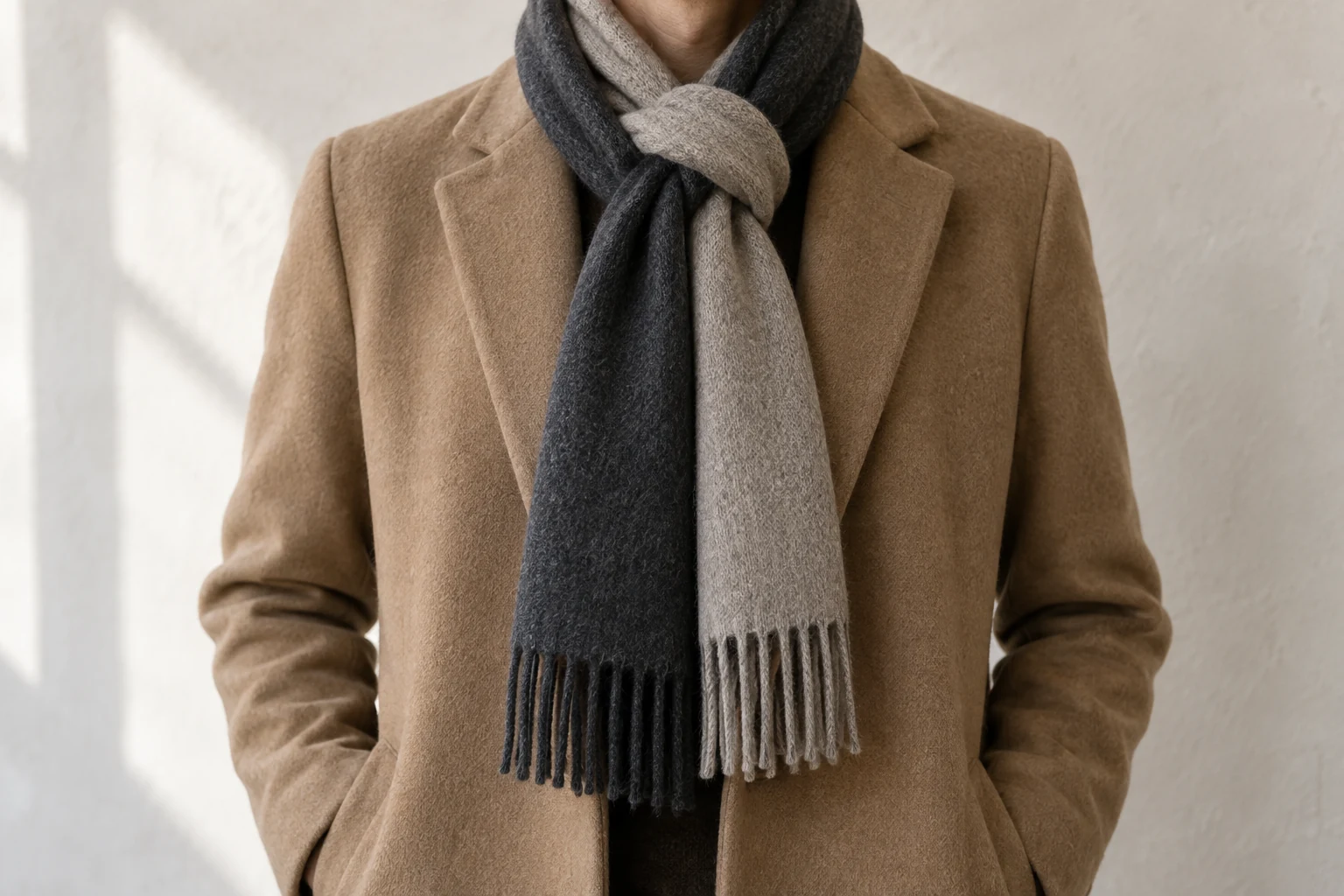
Check the length and fabric before choosing a knot
Put the scarf around the back of your neck with the ends even and look at where they fall. If both ends reach past your waist, you have a long scarf, and every knot in the next two sections will work. If they stop around your chest, choose a simple wrap, because a looped knot will use up most of the length. Thickness matters as much as length: a fine merino or cashmere scarf folds into a neat knot, while a chunky hand knit makes the same knot bulge and is often happier simply wrapped once.
Silk squares come in a few standard sizes. Hermès, whose silk carré is the reference point for many others, makes its classic scarf 90 cm (about 35 inches) on each side and also sells a smaller 70 cm square. A 90 cm square folds into a band long enough to go around the neck and tie with comfortable ends; smaller squares are better treated like a neckerchief or a bandana. Silk drapes well but lets knots loosen, so silk styles rely on a proper square knot or a loop rather than on friction.
Tie a long scarf with the Parisian knot
The Parisian knot, also called the loop knot or European knot, is the one most people mean when they ask how to tie a long scarf. It takes a few seconds, sits flat under a coat collar and covers the front of the neck. It works best with a scarf of medium thickness and at least 60 inches (150 cm) long, because folding it in half halves the working length.
Fold the scarf in half
Hold both ends together so the scarf doubles over. You should see a loop at the fold and the two ends side by side at the other end. If the scarf has a right side, keep it facing out.
Put it around your neck
Lay the folded scarf behind your neck so the loop hangs on your left side and the two ends hang on your right. Let the loop fall to about chest height.
CheckBoth halves should lie flat across the back of your neck without a twist.
Pull the ends through the loop
Reach through the loop from the front, take both ends and draw them through. The ends now come out of the loop and hang down your chest. Keep them flat as they pass through so the knot does not twist into a rope.
Slide the knot and settle it
Hold the ends and push the loop up toward your throat until it feels snug but not tight; about a finger's width of room is comfortable. Tug the ends to an even length.
CheckThe front of your neck is covered by the loop, and the two tails hang straight together below it.
Wrap it once or hide the knot when it is really cold
When the wind is sharp or the temperature is near freezing, a knot that leaves the sides of the neck open is not enough. The once around is the plainest wrap: drape the scarf with one end about twice as long as the other, then bring the long end around the front of your neck, around the back and forward again. Both ends hang in front, and a thick scarf holds itself in place this way without any knot, which also keeps it in a single layer under a buttoned coat. On the coldest days the scarf is only one layer of several, and our guide to dressing for 30 degree weather covers the rest.
The hidden knot adds one more move for the coldest days and works well with our list of what to wear in 40 degree weather. It needs a long scarf, so check the length first.
Make the once around
Wrap the long end around your neck once as described above, so both ends hang in front. Adjust until the ends are close to equal.
CheckOne band of scarf circles your neck and two ends fall down your chest.
Tie a loose knot close to your neck
Cross the end on your left over the end on your right and tie a single loose overhand knot just below your chin. Keep it loose enough to slip a finger inside, or the next step becomes a struggle.
Tuck the knot under the wrap
Push the knot up and slide it under the band that circles your neck, then smooth the band over it.
CheckNo knot is visible, your neck is covered all the way around and the ends hang from underneath the band.
Fold a silk square into a band first
Most ways to wear a silk scarf around the neck begin with a bias fold, which turns the square into a long band with pointed ends. Folding along the diagonal uses the full length of the square and hides the wrong side of a printed scarf, and because woven fabric has more give along the diagonal, the band curves around the neck instead of standing stiffly. Do this on a table rather than in the air.
Lay the square face down
Spread the scarf on a clean table with the printed side down and one corner pointing toward you. Smooth it flat; creases now become ridges later.
Fold two corners to the center
Bring the corner nearest you and the corner farthest from you to meet in the middle. You now have a shape with two long straight edges and two points at the sides.
Keep folding the edges to the middle
Fold each long edge in to the center line, then do it once more if you want a narrow band. Stop when the band is about 2 to 3 inches (5 to 8 cm) wide.
CheckA long flat band with a point at each end and only the printed side showing.
Two ways to wear a silk scarf on the neck
With the band made, the simplest style is the small side knot. Put the band around the back of your neck with the ends in front, tie a square knot (left end over right and under, then right over left and through) just off center, and let the two points fall at slightly different angles. A square knot matters with silk because a single overhand knot will slide loose within an hour. Above an open collar, a boat neck sweater or the neckline of a dress, this is the most reliable way to wear a scarf on the neck.
The looped knot below needs no second knot at all, so it lies very flat and is a good choice under a blazer or on a dress where a bulky knot would sit awkwardly against the neckline.
Tie a loose knot near one end
Make a loose overhand knot in the band about 6 to 8 inches (15 to 20 cm) from one tip. Leave it open enough to pass the band through.
Put the scarf on and thread the other end
Hang the scarf around your neck with the knot in front, then feed the plain end through the open knot.
CheckThe scarf now forms a closed ring around your neck, with both tips hanging below the knot.
Adjust and tighten gently
Slide the knot to the center or to one side and ease the tips to the lengths you like, then tighten the knot just enough to hold. The knot should look like a small flat rosette, not a hard ball.
How to tie a scarf on your head
The quickest head style is the headband. Make the bias band from the previous section, lay the middle across the top of your head or just behind the hairline, and tie the ends in a square knot at the nape of your neck, under your hair or over it. Leave the points out for a looser finish or tuck them in to keep it tidy. A wide band covers more hair and grips better than a narrow one.
For the classic head scarf, the one tied under the chin in so many photographs of Jackie Kennedy Onassis, fold a large square in half into a triangle instead of a band. Lay the long folded edge across your forehead with the point at the back, bring the ends down beside your face and tie them under your chin, or cross them at the nape and knot them there. Silk slips on smooth hair; a cotton square grips better, and a bobby pin at each temple will hold silk in place. Our guide to tying a bandana on your head or neck covers the smaller squares.
How men usually wear a scarf
Menswear writers tend to group scarf styles by how much warmth they give, which is a useful way to choose. With an open coat on a mild day, the simple drape (scarf around the back of the neck, ends even and hanging straight) shows off a pattern and gives almost no warmth; throwing one end over the opposite shoulder keeps it from swinging. When the coat is buttoned and it is genuinely cold, use the Parisian knot or the once around, or the hidden knot as the warmest of the three.
Over a suit or a tailored overcoat, a fine wool or cashmere scarf in the Parisian knot sits neatly inside the lapels, while a thick knit pushes the collar open. Relate the scarf color to the coat rather than to the tie; our guide to colors that go together has simple pairings. A small silk or cotton square knotted at the side of the neck also works with an open collar shirt, using the same folds as a bandana in a finer fabric.
| Style | Scarf | Warmth and use |
|---|---|---|
| Simple drape | Any long scarf | Almost no warmth, open coat on a mild day |
| Parisian knot | Medium thickness, at least 60 inches (150 cm) | Covers the front of the neck, sits under a collar |
| Once around | Long, even a thick knit | Warm, no knot, one layer under a buttoned coat |
| Hidden knot | Long scarf | Warmest, neck covered all the way around |
| Side knot or looped knot | Silk square folded into a band | Above an open collar, a blazer or a dress |
| Headband or head scarf | Silk or cotton square | Hair; cotton grips better than silk |
Common mistakes
Pulling the knot tight against your throat
A scarf pulled snug to the skin is uncomfortable and crushes the fabric into a hard lump. Leave a finger's width of room; the scarf still keeps wind out because the coat collar closes over it.
Using a thick scarf for a looped knot
A bulky knit folded in half doubles its thickness at your throat. If a Parisian knot turns into a thick collar that pushes your chin up, switch to the once around, which keeps the scarf in a single layer.
Leaving silk knotted overnight
Silk holds creases where it was knotted. Untie it when you take it off and hang it or lay it flat. If creases stay, follow our notes on caring for silk rather than pressing it with a hot iron.
Questions people ask
How do you tie a scarf the French way?
The phrase is used loosely. For a long scarf it usually means the Parisian knot, folded in half and pulled through its own loop, or a relaxed once around with the ends left uneven. For a silk square it usually means a narrow band tied in a small knot at the side of the neck. Both are described step by step above; the French part is mostly the loose, unfussy finish.
How do you tie a scarf the Italian way?
There is no single Italian knot, and the phrase is used loosely. It usually means the once around described above, worn loose, with one end hanging longer than the other, or a light wool or cotton scarf simply draped under an open coat or sport jacket. What people are describing is the ease: an unfussy wrap rather than a tight, symmetrical knot.
How long should a scarf be to tie it?
For looped styles such as the Parisian knot, a scarf about 60 inches (150 cm) or longer is easiest, because folding it in half halves the length. Shorter scarves work better with a simple drape or a single wrap. A silk square is judged by its side length instead; about 35 inches (90 cm) is large enough for most neck styles.
How do you wear a blanket or wrap scarf?
A large square or rectangular wrap is easiest folded into a triangle. Lay it over your shoulders with the point down your back, bring the two ends forward around your neck and let them hang in front or cross them loosely. For warmth, tuck the ends under a coat or secure them with a belt. Because these scarves are thick, avoid knots and let the size of the fabric do the work.
What is a scarf ring and how do you use one?
A scarf ring is a small ring or clip that holds a scarf in place instead of a knot. Thread both ends of a draped silk scarf through the ring and slide it up to where you want the knot to sit. It is useful with slippery silk, and it avoids creasing the fabric the way a tight knot does.
How do you wear a scarf with a dress?
A silk square folded into a band and tied in a small side knot suits most necklines, from a crew neck to an open collar. With a low or V neckline, the looped knot fills the space without adding bulk; our guide to necklines explains which shapes leave room for a scarf. A long scarf can also be draped loosely over the shoulders like a light wrap on a cool evening.
Sources and further reading
References used for this guide. Each opens the original page in a new tab.
- Grazia: how to tie an Hermès scarf, with scarf dimensions and classic styles Opens in a new tab
- The Vivienne Files: folding and tying a square scarf on the bias Opens in a new tab
- He Spoke Style: ten ways men tie a scarf, with warmth levels Opens in a new tab
- Hermès: how to tie a square scarf, carré sizes 70, 90 and 100 Opens in a new tab
Keep reading
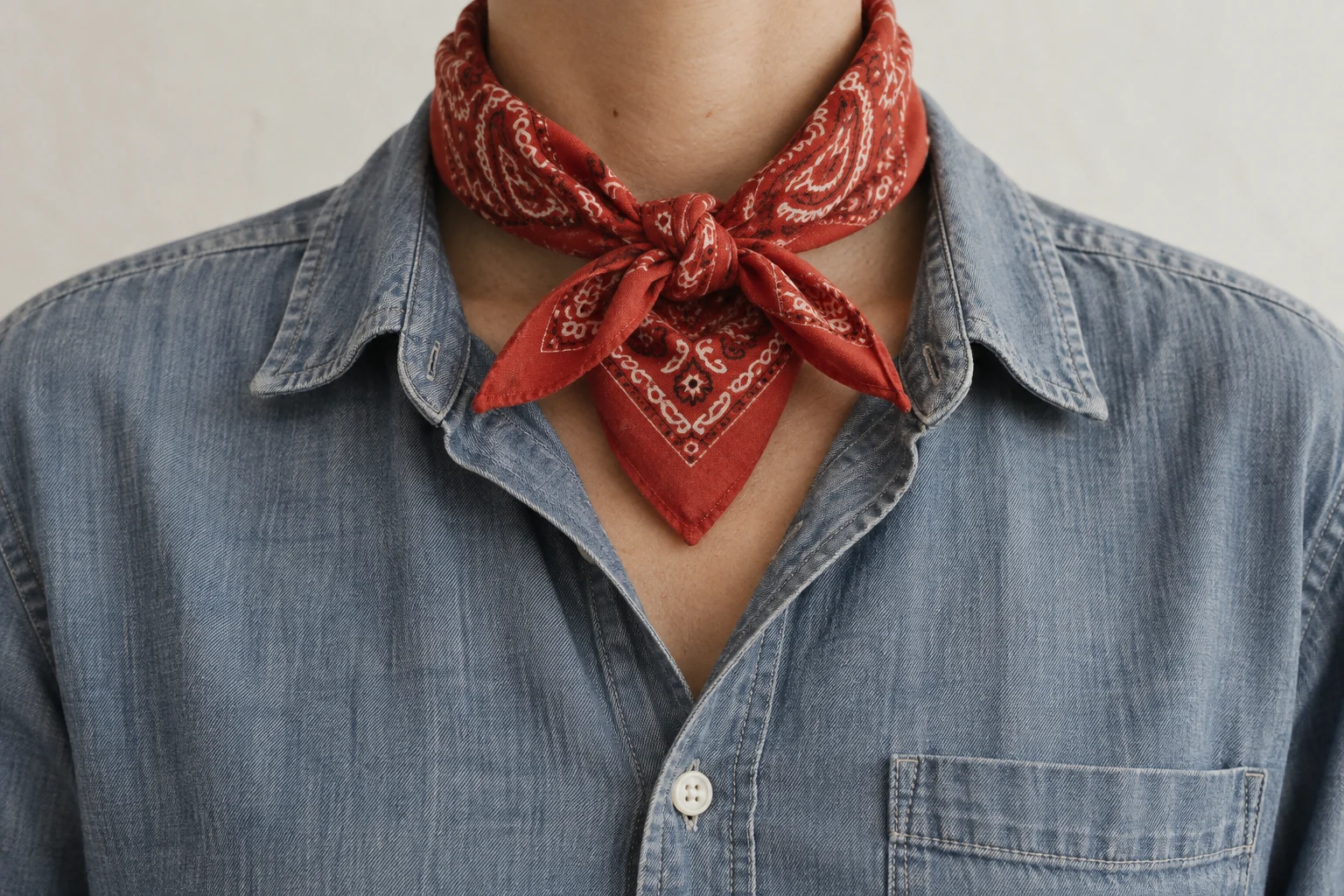
Everyday style
How to tie a bandana around your neck or head
How to tie a bandana, step by step: the two basic folds, classic neck styles, a head wrap that stays put, easy bandana hairstyles and ways guys wear one.
Washing and ironing
How to wash silk at home
How to wash silk safely: when the label says a cleaner is the better choice, how to test for color bleeding, and how to hand wash, dry and iron silk at home.
Weather
What to wear in 40 degree weather
At 40°F the wind and the rain matter as much as the number. How to layer, what to wear on your neck, hands and feet, and outfits for every hour outside.
Closet and packing
How to store sweaters: folding, seasons and moths
How to store sweaters day to day and between seasons: fold instead of hang, clean before packing, choose bins or bags with care, and keep clothes moths out.

Everyday style
What colors go together: color combinations for outfits
Practical color combinations for outfits: build on neutrals, try tonal dressing, add one accent, and test contrast against your own skin and hair in daylight.