Shoe size conversion: US, UK and EU for men and women
In this guide
A pair of shoes listed only in EU sizes, or unisex sneakers labeled only in men's sizes, can stall an order when you know your number in just one system. A shoe size conversion looks like it should be a simple lookup. In practice two charts from reputable sellers will often give you answers half a size apart, and both are telling the truth about their own shoes.
This guide explains the usual rules for moving between US men's, US women's, UK and EU sizes, and where each rule bends. It also shows you how to measure your own foot, because a length in centimeters is the one number every brand's chart can be read against.
Why shoe size conversion charts disagree
A shoe size describes the last, the foot shaped form the shoe is built on, not your foot. The last is longer than the foot it is meant for, by roughly half an inch to two thirds of an inch, and every maker decides that allowance for itself. On top of that, the systems count in different steps. US and UK sizes move in thirds of an inch, an old unit called the barleycorn, while EU sizes move in Paris points of two thirds of a centimeter. The steps never line up exactly, so any conversion is a rounding decision.
That is why a large retailer such as Zappos warns that the right size varies from style to style even within one manufacturer, and why the Brannock Device Company, which makes the metal foot measure used in American shoe stores, tells fitters that sizes vary between makers and styles. Use conversion rules to find a starting point. Use the brand's own chart, read against your foot length, to decide.
Measure your foot length first
Measure at the end of the day. The American Academy of Orthopaedic Surgeons notes that feet can swell by up to about 8 percent over a day, and recommends standing while you are measured. Wear the kind of socks you plan to wear with the shoes.
Set up paper against a wall
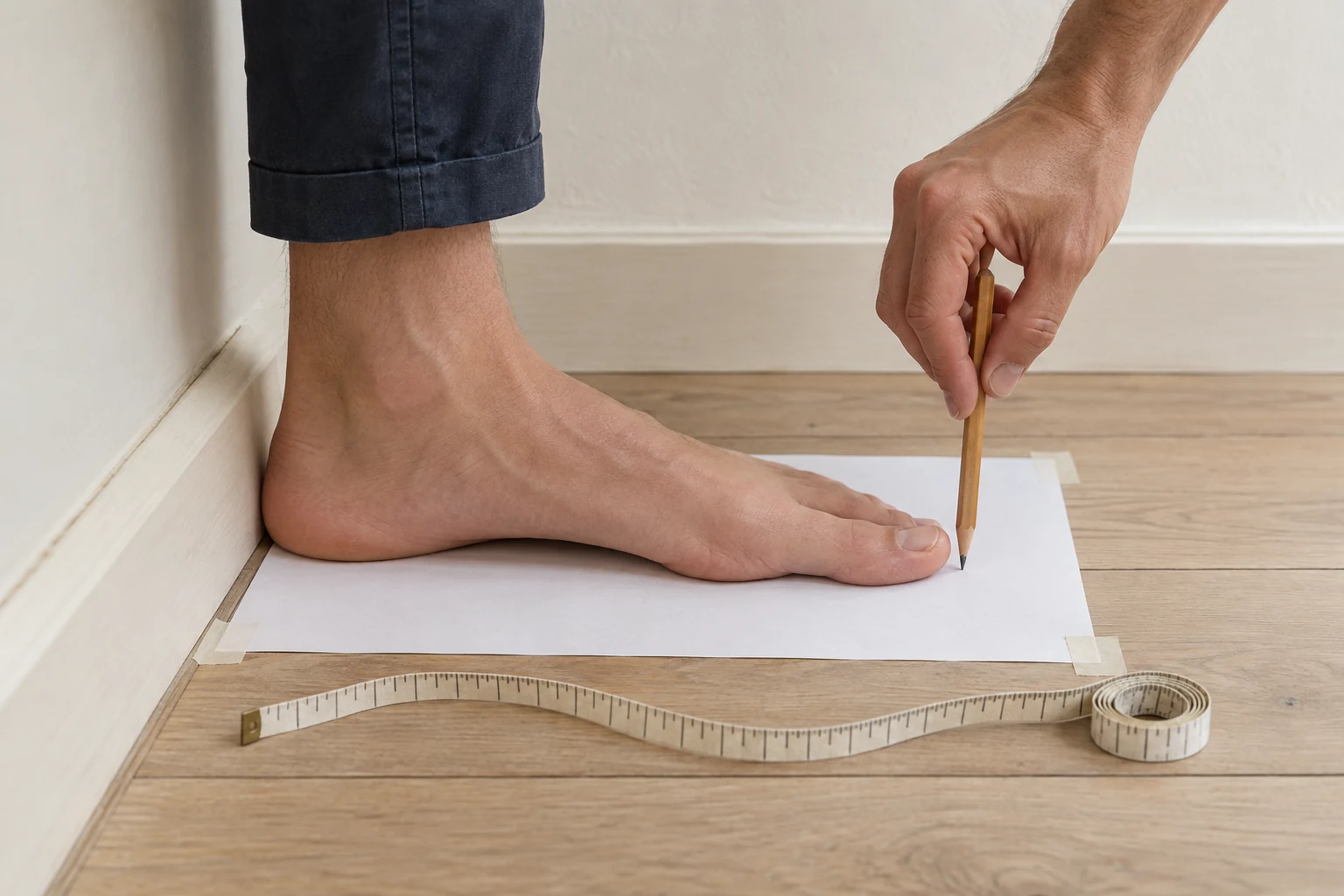
Tape a sheet of paper to a hard floor with one short edge touching a wall. A carpet lets the foot sink and spreads it, so find a bare floor.
Stand with your weight even
Stand with your heel against the wall and your weight shared equally between both feet. Brannock's instructions use equal weight so the foot lengthens as it does when you walk.
Mark the longest toe
Stand a hardcover book on its edge and slide it along the paper until it touches the tip of your longest toe, which is not always the big toe. Step back and draw a line along the book's edge. The book keeps the mark square to the paper, which a slanted pencil would not, and it means you can do this alone; a helper holding a pencil straight up and down works too.
Measure both feet and keep the larger number
Measure from the wall edge of the paper to the mark in centimeters and in inches. Repeat for the other foot. It is common for one foot to be longer, and Brannock advises fitting the larger foot.
Convert women's and men's US sizes
The most common rule is that a US women's size is 1.5 sizes larger than the US men's size for the same shoe. On Nike's charts a women's 8.5 matches a men's 7 and a women's 10 matches a men's 8.5, so a women's size 9 in men's is about a 7.5. Going the other way, subtract 1.5 from a women's size to find the men's or unisex size, and add 1.5 to a men's size to find the women's.
The rule is a convention, not a law. One older industry scale puts women's sizes just one size above men's, and Zappos gives a general difference closer to two sizes. So a women's 9 might be sold as a men's 7, 7.5 or 8 depending on the chart. For unisex sneakers, look for the maker's own column that lists both sizes together. Remember too that men's and women's versions of a model can be cut on different lasts, so the same length does not guarantee the same width or heel fit.
Convert between US and UK sizes
UK sizes use the same third of an inch steps as US sizes, but they start from a different point, so they read smaller. For men, the gap is usually half a size to one size: Zappos and Nike both list a US men's 9 as a UK 8.5, while many traditional British shoemakers count a full size apart and would call it a UK 8. For women, the gap is larger, usually 2 to 2.5 sizes, with a US women's 7 given as a UK 5 by Zappos and a UK 4.5 by Nike.
Because UK sizing does not split men and women the way US sizing does, a UK 7 can be a man's or a woman's shoe. When a British or European brand lists only UK sizes, find its conversion page and look at where your foot length in centimeters falls, rather than subtracting a fixed number.
Convert EU sizes to US sizes
EU sizes are the same for men and women, which makes them useful and confusing at once. A 40 is a 40 whether the shoe is sold as men's or women's, but it converts to two different US numbers. Zappos offers a rough rule of adding 31 to a US size. It works tolerably for women's sizes, turning a women's 9 into a 40 where its chart shows 39 to 40, but not for men's, where the same chart puts a men's 9 at 42. That mismatch shows why a formula is only a sketch.
Here is where some common EU sizes land on two large charts. An EU 38 is a US women's 7 at Nike and sits between a women's 7 and 8 at Zappos. An EU 39 is a women's 8 at Nike and between 8 and 9 at Zappos. An EU 40 is a men's 7 or a women's 8.5 at Nike. An EU 42 is a men's 8.5 at Nike and a men's 9 at Zappos. An EU 43 is a men's 9.5 at Nike and a 10 at Zappos. Where two charts differ by half a size, the brand you are buying from is the tiebreaker.
Some brands, especially European ones, make only whole EU sizes, with no halves. If your foot falls between two EU sizes, the style matters: a lace up shoe can be snugged with the laces, while a loafer or a pump has nothing to tighten, so it has to fit by length and width alone.
Convert kids' and youth sizes to adult sizes
Big kids' shoes are labeled with a Y, for youth, and Nike's chart runs them from 1Y to 7Y. They are useful to know because youth sizes often overlap with small adult feet, and a youth sneaker can cost less than the adult version of the same model. On Nike's chart a youth size carries the same number as the US men's size, so a 5Y is a men's 5, and the US women's equivalent is 1.5 higher, which makes a 6.5Y a women's 8 and an EU 39. A 7Y, the largest, matches a men's 7 and a women's 8.5.
The conversion holds on length, but youth shoes are built for children's feet and may be cut narrower or with less cushioning than adult models. Compare foot lengths in centimeters on the maker's chart rather than relying on the 1.5 step alone, since some brands use a slightly different offset.
| From | To | Usual rule |
|---|---|---|
| US women's | US men's | Subtract about 1.5 sizes |
| US men's | UK | Half a size to one size smaller |
| US women's | UK | Usually 2 to 2.5 sizes smaller |
| US women's | EU | Add about 31, a rough sketch that fails for men |
| Youth (Y) | US adult | Same number as men's, about 1.5 lower than women's |
Charts disagree by half a size, so the brand's own chart and your foot length decide.
Choose between two sizes and check the fit
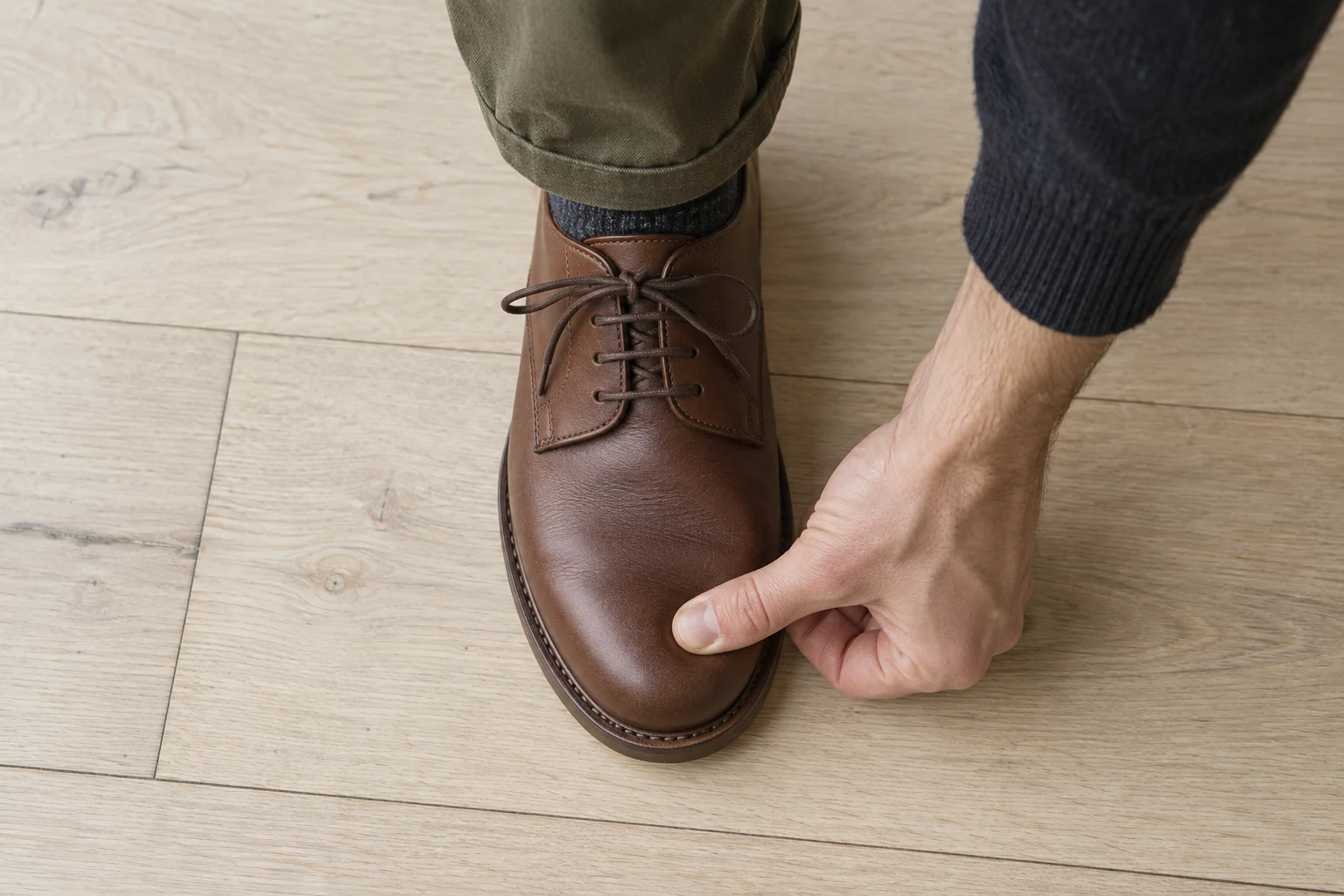
When your foot length falls between two sizes on a brand's chart, Nike recommends sizing up, and that is sensible advice for most shoes. The AAOS suggests leaving about half an inch between your longest toe and the end of the shoe. Feel for it with your thumb while standing, and walk on a hard floor, not only a carpet, before you decide. Our guide to how shoes should fit walks through the rest of the checks, from width to heel grip.
Do not count on shoes stretching to fit. Brannock's fitting notes say that if a shoe does not feel right when you buy it, it probably never will. Leather can relax a little across the width, and our guide to stretching shoes covers what is realistic, but length does not grow. If a shoe is right in length but your heel lifts, try a different lacing method before changing size. If the instep feels tight in a closed lace style, an open laced derby may fit where an oxford does not; the difference is explained in our guide to oxford and derby shoes.
Common mistakes
Converting from a size you have not measured recently
The AAOS recommends having your feet measured every year, because feet change with age and weight. A size you last checked a decade ago is a weak starting point for a conversion.
Measuring in the morning
Feet are at their smallest early in the day. A size chosen then can feel tight by evening, so measure and try shoes on later in the day.
Applying one conversion rule to every brand
The 1.5 size rule and the add 31 rule are rough averages. Read each maker's own chart against your foot length, and treat the rules only as a check that the answer is in the right neighborhood.
Questions people ask
What is a size 39 shoe in US sizes?
An EU 39 is usually a US women's 8 to 9 and a US men's 6.5 or so. Nike lists it as a women's 8, while Zappos places a women's 8 to 9 around 38 to 40. Check the brand's chart against your foot length before ordering.
What is a women's size 9 in men's?
On the most common rule, subtract 1.5, which makes a women's 9 a men's 7.5. Some charts give a men's 7 or 8 instead, so if you are buying unisex shoes, use the maker's chart that lists both columns side by side.
What is a women's size 12 in men's and EU sizes?
The common 1.5 size rule gives a men's 10.5, but Nike's women's chart lists a women's 12 as a men's 10, a UK 9.5 and an EU 43, for a foot about 28.5 cm long. The gap between women's and men's sizes widens a little at the top of some charts, which is another reason to compare foot length rather than subtract a fixed number.
Are EU shoe sizes the same for men and women?
Yes, a given EU number describes the same length for either sex. What differs is the US number it converts to, because US women's and men's scales are offset. The shoes themselves may also differ in width and shape between men's and women's versions.
Should I size up or down if I am between sizes?
For most shoes size up, as Nike recommends, and then fine tune with laces, socks or an insole if needed. A shoe that is slightly long can often be made to work, but a shoe that is too short cannot.
Sources and further reading
References used for this guide. Each opens the original page in a new tab.
- Wikipedia: shoe size systems, barleycorns, Paris points and lasts Opens in a new tab
- American Academy of Orthopaedic Surgeons, OrthoInfo: shoes, finding the right fit Opens in a new tab
- Nike men's footwear size chart and foot measuring instructions Opens in a new tab
- Zappos shoe size conversion charts Opens in a new tab
- Brannock Device Company: fitting instructions and tips Opens in a new tab
- Nike women's footwear size chart Opens in a new tab
- Nike big kids' footwear size chart Opens in a new tab
Keep reading
Sizing
How should shoes fit? Toe room, width and heel
How should shoes fit? Check toe room, width and heel grip, learn the signs that shoes are too big or too small, and what changes for running shoes, boots and heels.
Shoes and jewelry
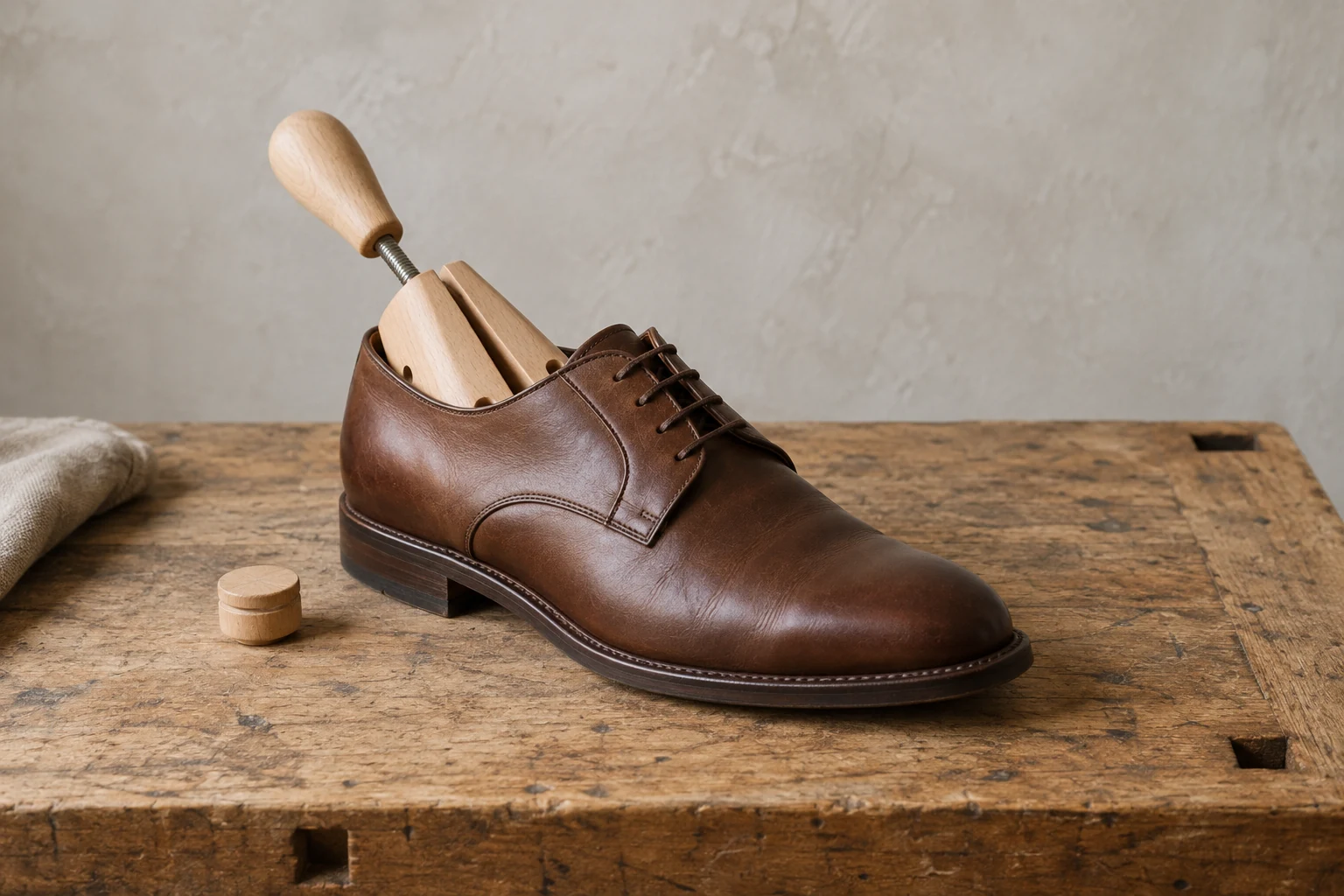
How to stretch shoes that feel too tight
How to stretch shoes that pinch: what leather can and cannot do, using a shoe stretcher and thick socks, the risks of heat and ice, and when to see a cobbler.
Shoes and jewelry
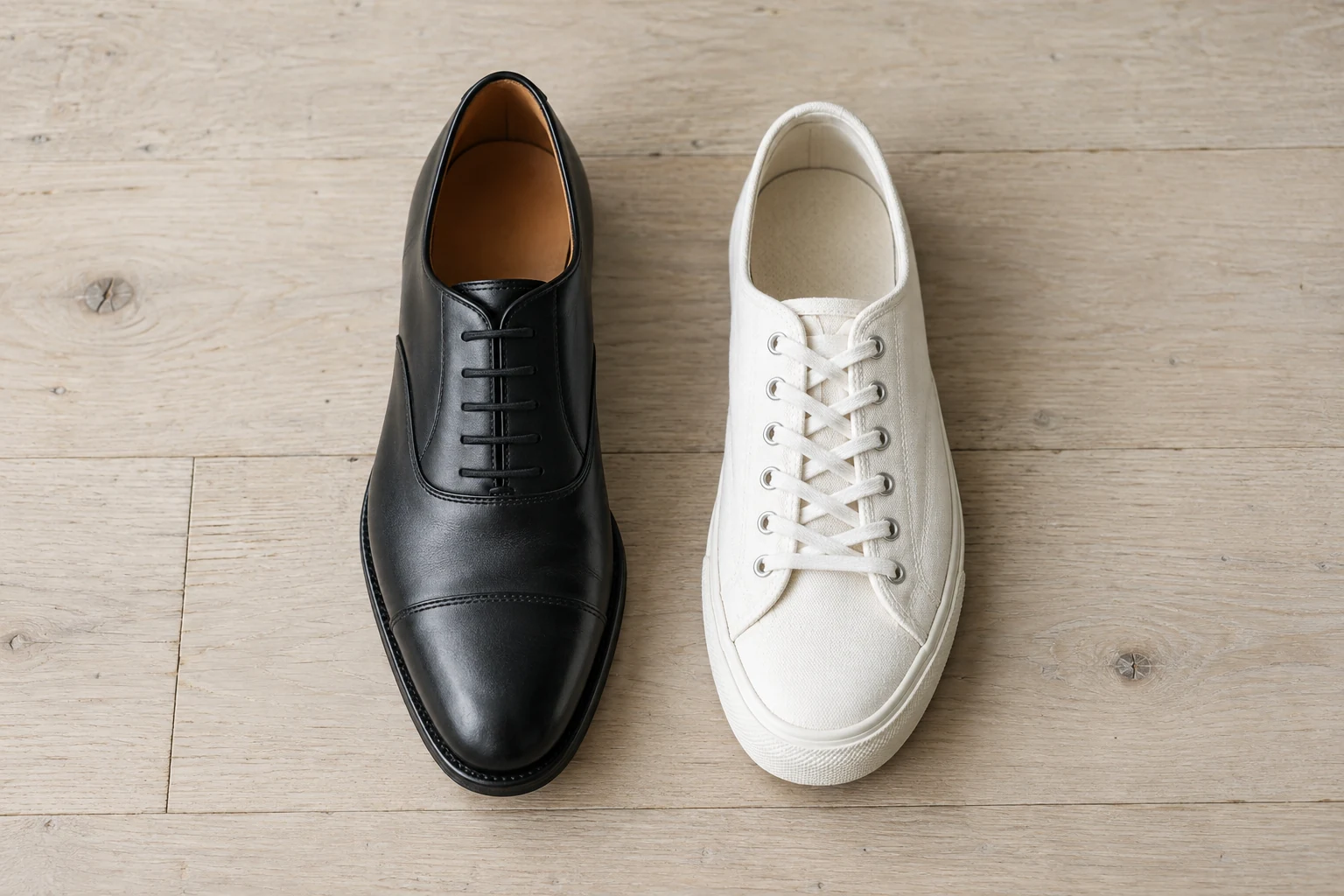
How to lace shoes: straight bar, criss cross and more
How to lace shoes for the job: criss cross for sneakers, straight bar lacing for dress shoes, a heel lock against slipping, and a bow knot that stays tied.
Suits and tailoring
Oxford vs derby shoes: the difference and when to wear each
Oxford vs derby shoes explained: closed and open lacing, which is more formal, which fits a high instep, where brogues and bluchers fit, and what to wear with each.
Sizing
How to measure inseam for pants, jeans and shorts
Measure your inseam from pants that fit or on your body, see how inseam differs from outseam, and choose the right length for jeans, dress pants, shorts and bikes.