Business casual for men: what to wear to work
In this guide
The offer letter says the dress code is business casual, and you are looking at a closet that holds one interview suit and a lot of weekend clothes. The phrase sounds precise, but it is not. Business casual for men has no official definition in the United States, and the version worn at a regional bank looks noticeably different from the version at a software company two blocks away. What stays constant is the logic: start from the suit your workplace would once have expected, take away one layer of formality, and keep everything clean, pressed and fitted.
Below are the core outfits, a straight answer to whether jeans are business casual, and notes on shoes, seasons and fit, plus how to read your own office so you are neither the only man in a tie nor the only one in sneakers. The companion guide to business casual for women follows the same logic with different garments.
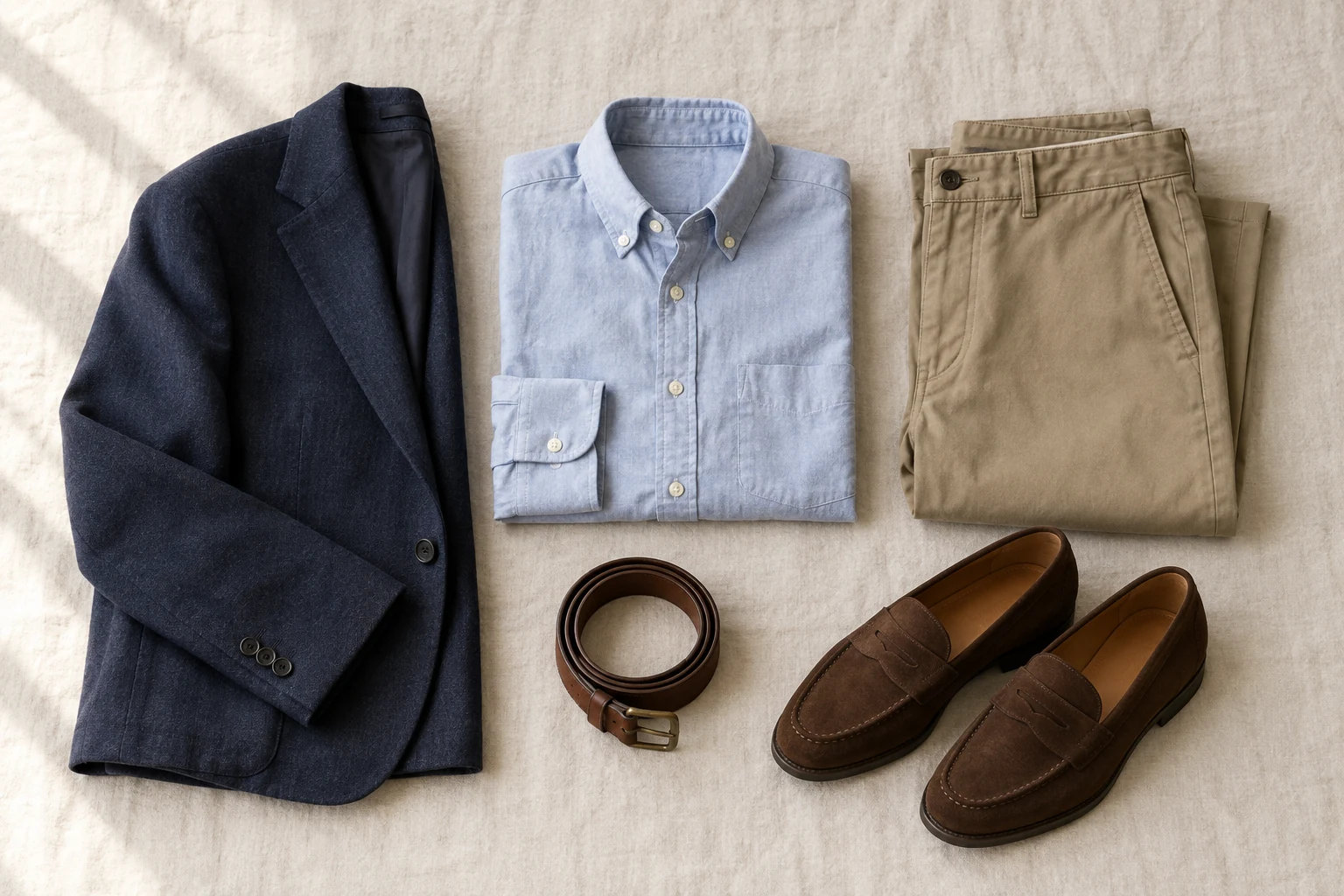
What business casual means for men
The Emily Post Institute describes business casual as a relaxing of usual standards, roughly one notch down from what a workplace would normally expect. That definition is more useful than any shopping list, because it tells you the answer depends on the starting point. In an office where people once wore suits every day, one notch down means a sport coat, a pressed dress shirt, wool trousers and leather shoes, with the tie left at home. In a workplace that was already relaxed, it means chinos, a button down or a fine knit, and leather shoes or very clean, simple sneakers.
Between those two ends sits the version most American men wear on most days: chinos or wool trousers in navy, gray, khaki or olive, a collared shirt tucked in with a leather belt, and leather shoes. A jacket is the piece you add for a client meeting or a presentation, and a tie is rarely expected. What keeps all of this business casual rather than simply casual is condition and fit. Creighton University's career center puts the standard in practical terms: clothes should be clean, pressed and show no wear, and the outfit should look right even if you ran into the chief executive in the hallway.
Read your own office first
Industry sets the baseline. Finance, law, government and client facing sales roles tend to sit at the dressier end, so business casual there often means a blazer in meetings and no jeans at all. Technology, design, media, education and many nonprofits sit at the relaxed end, where a sweater and chinos may be the dressiest outfit in the room. Duke University's career center suggests researching a company's culture through its website, its social media and conversations with people who work there, which is sensible before your first day.
Spend your first week noticing what people one or two levels above you wear on an ordinary Tuesday, not at the holiday party and not on Friday. Read the written policy if there is one, since it may name specific exclusions such as jeans, shorts or open toed shoes. If something is still unclear, ask your manager a narrow question (are dark jeans fine on days without clients?) rather than a vague one. Your clients' dress code counts too: when you visit a law firm, dress for their office, not yours.
Climate and schedule shift the answer further. An office in Phoenix or Miami will be more relaxed about linen and polos in July than one in Chicago in January, and on hybrid schedules the office days are often the meeting days, which pulls them slightly dressier. Dress codes also have legal limits: the Equal Employment Opportunity Commission explains that under Title VII employers generally must accommodate religious dress and grooming, such as head coverings or beards, unless doing so would cause substantial hardship.
Business casual outfits for men that work
Most business casual clothes for men come down to four combinations you can repeat in different colors. They run here from dressiest to most relaxed, so pick the one that matches your office and the day on your calendar.
For client meetings and presentations, wear a navy or gray sport coat, a light blue or white oxford cloth shirt, mid gray wool trousers, a brown leather belt and brown leather shoes. This is the upper edge of business casual and it looks correct almost anywhere in the country. The jacket does the work a suit would do, while the unmatched trousers keep the outfit from feeling like a job interview. Add a tie only if the people you are meeting wear them.
For an ordinary day, the core outfit is pressed chinos in khaki, navy or olive with a solid or finely striped button down, tucked in, plus a belt that matches your shoes. Keep the shirt collar crisp and the trousers free of fading at the knees. This carries most American offices five days a week, and it is what you fall back on when you are not sure. Our guide to tucking in a shirt so it stays neat helps if your shirts keep billowing over the belt by lunchtime.
In cooler months, swap the jacket for knitwear. A merino crew neck or V neck sweater over a collared shirt, with charcoal wool or flannel trousers and brown leather or suede shoes, looks deliberate and keeps you warm. Let the shirt collar sit inside the sweater's neckline, and choose a knit thin enough to lie flat under a coat.
In a relaxed office in summer, a plain polo or a knitted polo with chinos and loafers is business casual in many workplaces, and the Emily Post Institute includes polos in its list. A polo with a big logo, a curling collar or an athletic cut reads as golf rather than work, though. Creighton's career center prefers long sleeves even in summer, and a lightweight shirt with long sleeves and the cuffs rolled once or twice usually looks neater than a short sleeve dress shirt while handling the air conditioning better.
Are jeans business casual?
Not by default. In a traditional American office, jeans are not business casual; the Emily Post Institute calls them usually a no, and Creighton's career center tells students to leave them out entirely. The exception is real, though. Duke's career center notes that some industries and companies allow dark denim as part of business casual, and in much of the technology sector, in creative agencies and in many small businesses, dark jeans with a collared shirt are ordinary office wear.
The quickest way to know is to look. If managers and people who meet clients wear jeans on regular weekdays, you can too. If jeans appear only on Fridays, denim belongs to that day. If you never see them, do not be the first, and check whether the written policy limits jeans to certain days or to days without client contact.
When jeans are allowed, they still need to look like work clothes. Choose a dark, even indigo or black wash with no rips, heavy fading or whiskering, in a straight or slim cut hemmed to meet your shoes with little or no bunching. Then dress everything else up: a tucked collared shirt or a fine knit, a leather belt, leather shoes or boots, and a blazer on busy days. The top half and the shoes carry the formality, so this is not the moment for sneakers and a T shirt.
Business casual shoes for men
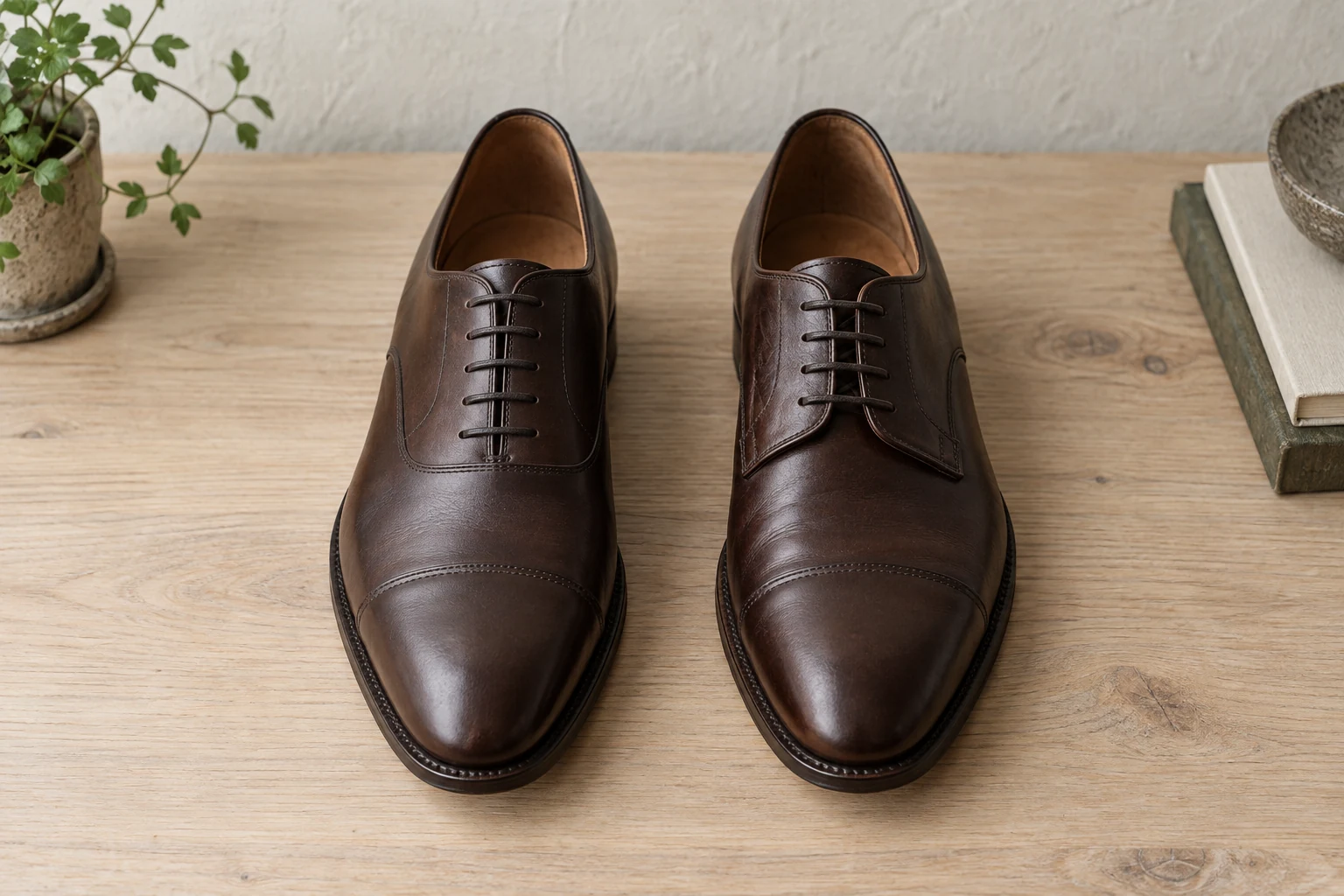
Leather shoes are the safe choice, and picking among them is mostly about how dressy your office is. Brown leather loafers and derbies cover almost every business casual situation, go with navy, gray, khaki and olive trousers, and look right with or without a jacket. Suede loafers and chukka boots are slightly more relaxed and suit fall and winter. Black oxfords are the most formal of the business casual dress shoes for men and can look stiff with chinos, so save them for dressier days with gray trousers. If the difference is new to you, our guide to oxford versus derby shoes explains how the lacing changes the formality.
Sneakers are the gray area. The Emily Post Institute considers them usually out of place, while allowing that clean, simple pairs work in more casual workplaces. If colleagues wear them, choose plain leather sneakers in white, black or a dark neutral, keep them spotless, and never wear running or gym shoes to work. Sandals, flip flops and hiking boots are out almost everywhere. Finish with dark socks long enough that no skin shows when you sit, as Creighton advises, and a belt close in color and finish to your shoes; the rules for matching belt, shoes and socks are simpler than they look.
| Shoe | Where it fits | Wear it with |
|---|---|---|
| Black oxfords | Dressier days and client meetings | Gray wool trousers, not chinos |
| Brown leather loafers or derbies | Almost every business casual office | Navy, gray, khaki or olive trousers |
| Suede loafers or chukka boots | Slightly relaxed offices in fall and winter | Flannel, wool or chinos |
| Plain leather sneakers | Only where colleagues already wear them | Chinos; keep them spotless |
| Sandals, flip flops, hiking boots | Out almost everywhere | Save for the weekend |
Match your belt to your shoes and choose dark socks long enough that no skin shows when you sit.
Adjust for season and climate
Summer business casual is mostly about fabric. Lightweight cotton chinos, tropical wool trousers and linen blends breathe better than heavy twill, and cotton poplin shirts dry faster than thick oxford cloth. Pure linen wrinkles within an hour of sitting, which is fine in a relaxed office and less fine before a client meeting. Shorts are not business casual in most offices even in a heat wave unless your employer says so, and in hot cities commuting in a T shirt and changing at your desk is a sensible answer.
Winter lets you add texture. Flannel and heavier wool trousers, merino and lambswool sweaters, corduroy in relaxed offices, and leather or suede boots all read as business casual in good condition. Offices are often warm while the commute is cold, so choose layers you can remove, such as a sweater over a shirt, and if you wear snow boots on the way in, keep leather shoes under the desk.
Fit and condition matter more than labels
Two men can wear identical chinos and a blue shirt and look completely different at work, and the difference is nearly always fit and care. Trousers should sit at or just below your natural waist, with a hem that meets the top of the shoe with a slight break or none; our guide to how long dress pants should be shows exactly where that falls. Shirt shoulder seams should end at your shoulder bone, and the collar should close without pinching even if you never button it. A sport coat should lie flat across your back and let a little shirt cuff show, the same checks a tailor uses for a suit jacket.
Condition is the other half. Press shirts and chinos, retire shirts whose collars have frayed or yellowed, and brush or polish leather shoes regularly. A tailor can hem trousers or take in a shirt for much less than replacing them, which often does more for a business casual wardrobe than a new blazer.
Common mistakes
Wearing a full suit every day in a relaxed office
A matching suit on your first day is a safe choice, but wearing one daily where nobody else does can make you look out of step, and the trousers wear out long before the jacket. Break it up instead. Wear the jacket with chinos or the trousers with a sweater, as long as the suit fabric is plain enough to pass as separates.
Leaving a dress shirt untucked
Dress shirts are cut long so they stay tucked, and worn out they hang past the seat and look sloppy. If your office accepts untucked shirts, choose ones with a shorter, straight hem made to be worn that way, and keep them for relaxed days.
Using a blazer to rescue a casual outfit
A sport coat over a graphic T shirt, ripped jeans or running shoes does not make the outfit business casual; it makes a casual outfit with a jacket on top. The jacket belongs on a business casual base of trousers, a collared shirt or knit, and leather shoes.
Questions people ask
Is a polo shirt business casual?
In many American offices, yes, especially in summer and in relaxed industries, and the Emily Post Institute includes polos in its business casual list. Choose a plain polo in a solid color with a collar that holds its shape. Avoid athletic fabrics, large logos and faded collars. In traditional offices, keep polos for Fridays.
Do men need to wear a tie for business casual?
No. A tie is optional in business casual and most offices do not expect one. It is a useful addition on a day with an important client or when you are unsure how dressy a meeting will be, because it is easy to take off and put in a pocket. A tie worn with a sweater and flannel trousers also looks natural in winter.
What is the difference between business casual and smart casual?
Business casual is shaped by workplace expectations, while smart casual is usually a social dress code with more room for personal style, dark jeans and clean sneakers. Business casual tends to be more conservative in color and fabric. On the usual ladder of dress codes, smart casual sits one step below business casual and dressy casual one step above it. Our guide to the smart casual dress code covers dinners, parties and other social settings.
What should I wear to an interview at a business casual company?
Dress one step above the everyday level. For most business casual workplaces that means a blazer, a pressed collared shirt, wool trousers and leather shoes, with a tie if the company or industry is traditional. Our guide on what to wear to a job interview covers suits, industries and video calls.
What does business professional mean for men?
Business professional, sometimes called business formal, means a matching dark suit, a dress shirt, a conservative tie and leather dress shoes, according to the Emily Post Institute. It is still standard in some law firms, banks, courtrooms and government settings. Business casual is essentially that outfit with the suit broken up and the tie removed, and our guide to business professional attire covers the full version.
What is not allowed in business casual?
Written policies differ, but most American offices rule out athletic wear, graphic T shirts, hoodies, shorts, flip flops and sandals, ripped or faded jeans, and caps worn indoors. Anything wrinkled, stained or visibly worn falls short too, however formal it once was. If your employer has a policy, it overrides any general list, including this one.
Sources and further reading
References used for this guide. Each opens the original page in a new tab.
- Emily Post Institute: Business casual 101 Opens in a new tab
- Creighton University Career Center: Business casual dress for men Opens in a new tab
- Duke University Career Hub: Attire guide Opens in a new tab
- Emily Post Institute: Attire guide from casual to white tie Opens in a new tab
- US Equal Employment Opportunity Commission: Religious garb and grooming in the workplace Opens in a new tab
Keep reading
Dress codes
Business casual for women: what to wear to work
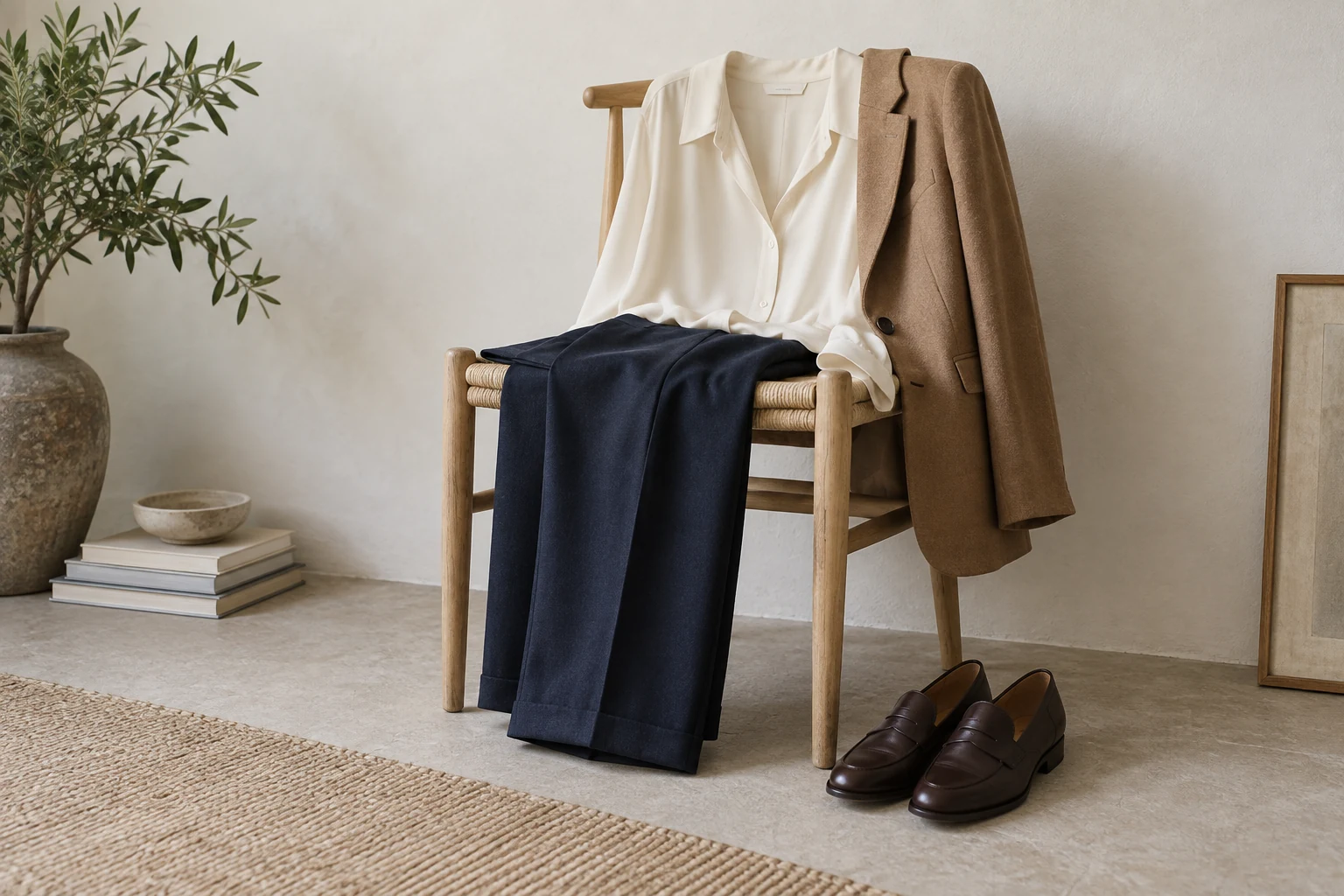
What business casual means for women at work: trousers, skirts, dresses, knitwear and shoes, with outfit formulas, what to avoid and how to read your office.
Dress codes
Smart casual: what it means for men and women
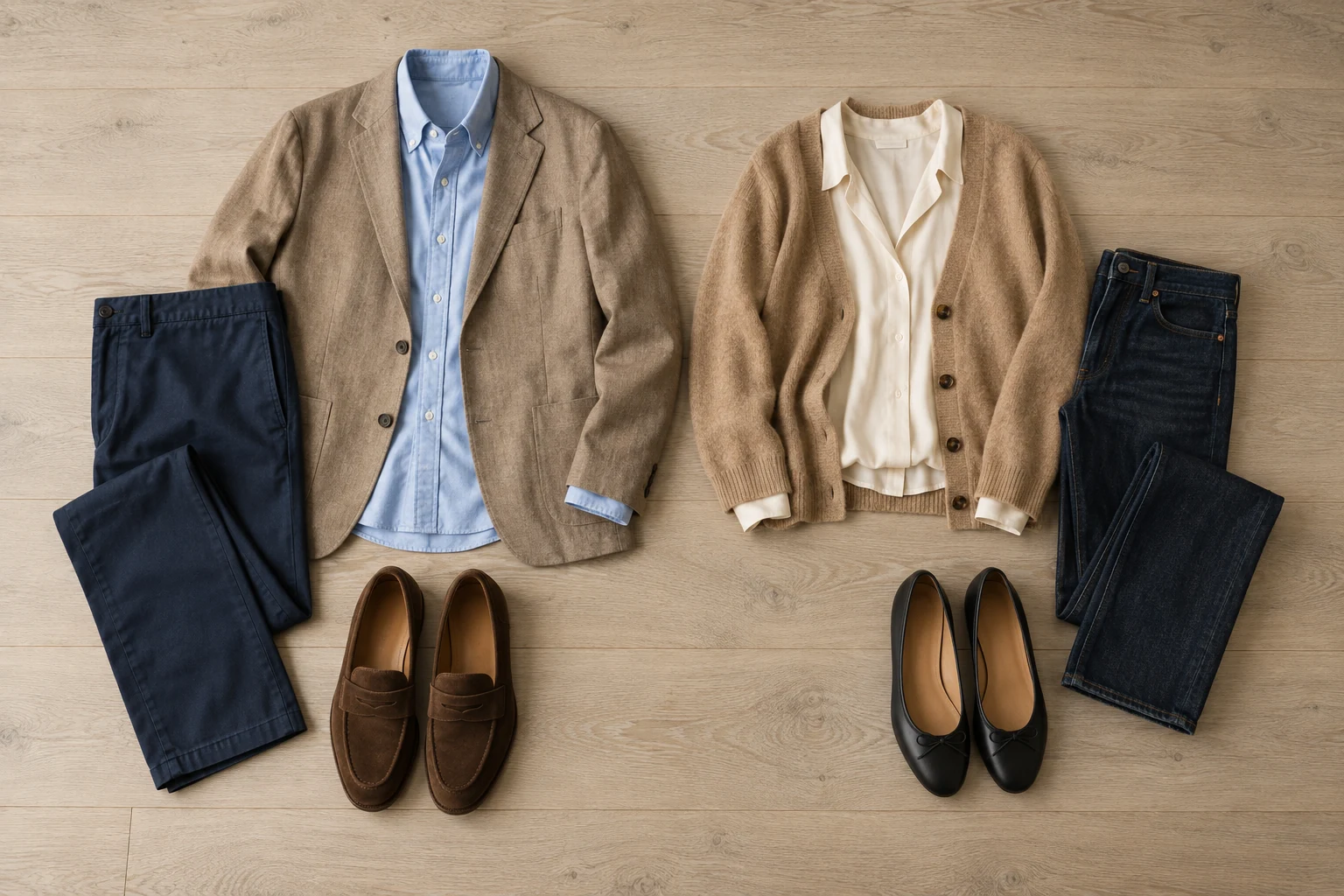
What smart casual really means, how it differs from business casual, and what men and women can wear, including when jeans, sneakers and a blazer are right.
Dress codes
What to wear to a job interview
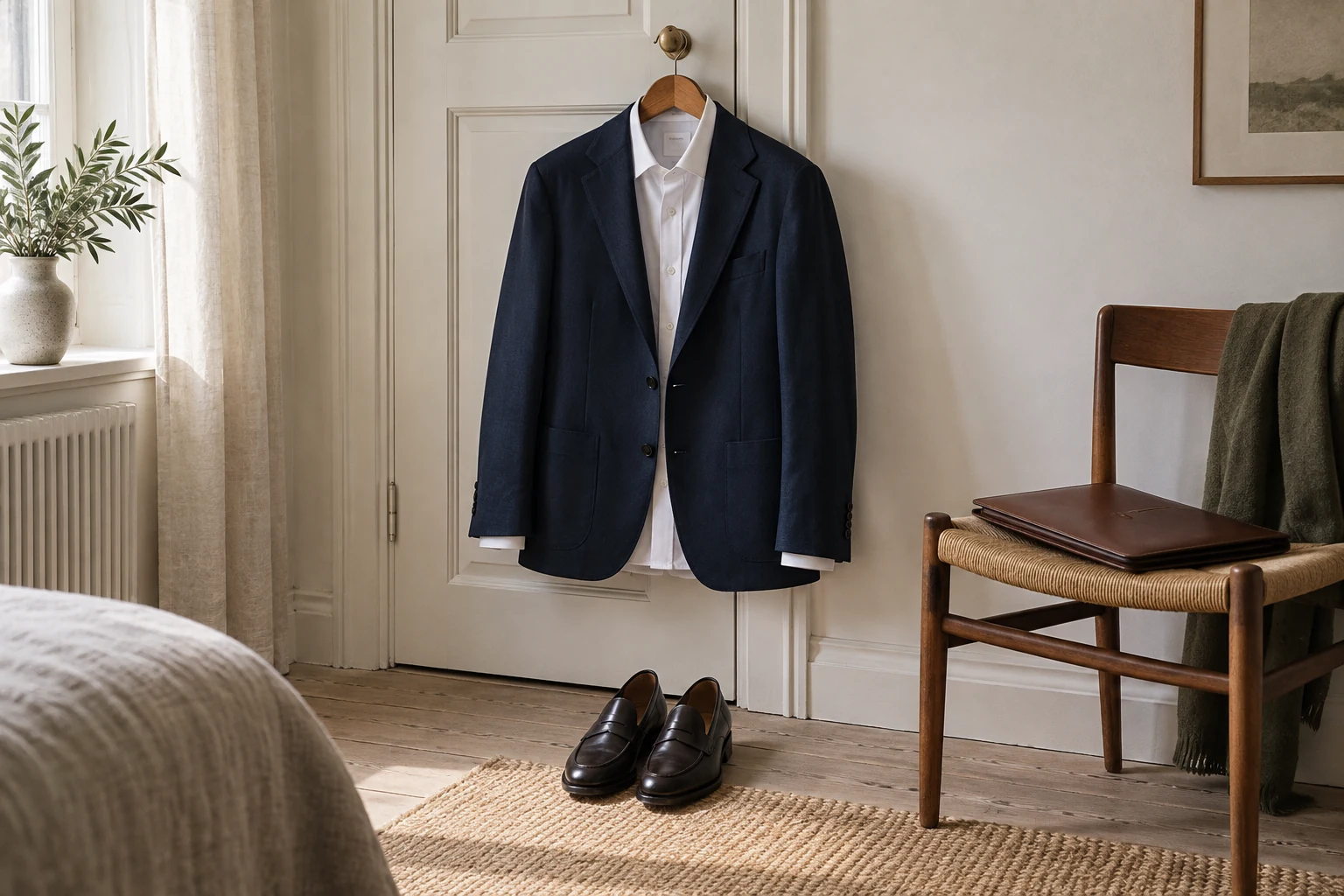
What to wear to a job interview: how to read the company, dress one step above daily wear, outfits for men and women, video interviews and what to avoid.
Suits and tailoring
Oxford vs derby shoes: the difference and when to wear each
Oxford vs derby shoes explained: closed and open lacing, which is more formal, which fits a high instep, where brogues and bluchers fit, and what to wear with each.
Suits and tailoring
How a suit should fit: shoulders, sleeves and length
How should a suit fit? Check the shoulders, collar, button, jacket length, sleeves and trousers in the mirror, and learn which problems a tailor can and cannot fix.