Hat size chart: how to measure your head for any hat
In this guide
A size such as 7 3/8 looks more like a fraction from a math class than a measurement, yet it is the number a fitted cap or a felt hat will ask you to choose. Every hat size chart starts from one measurement, the distance around your head where the hat's inner band will rest. Take it well and the chart does the rest; take it a little too high or too tight and you can end up a size off.
This guide shows how to measure, how the fractional sizes relate to inches and centimeters, and how to choose between sizes for fitted caps, adjustable caps, brimmed hats and hats you knit or crochet yourself.
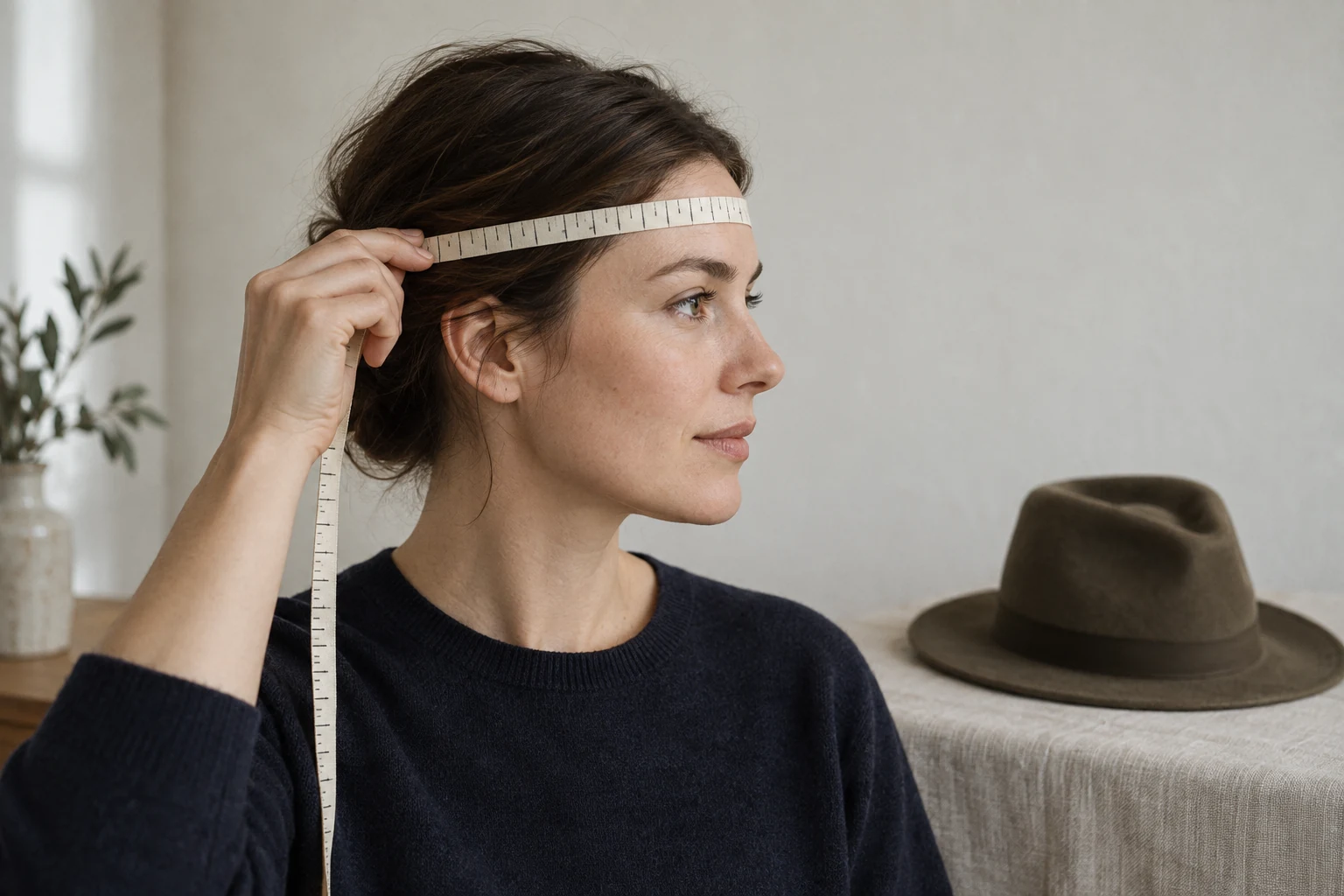
How to measure hat size at home
Use a soft sewing tape. If you only have string, Stetson suggests wrapping that and measuring it against a ruler afterward; just keep it from stretching. A mirror or a helper makes it easier to keep the tape level at the back.
Place the tape where the hat sits
Start at the middle of your forehead. Stetson places the tape about 1/8 inch above the ears, while New Era describes about half an inch above the eyebrows and ears for its caps. Both describe the line a hat's sweatband follows, so aim for that line rather than the top of your head.
Keep it level around the back
Bring the tape around the back of your head, over the fullest part, and back to the start. Check in a mirror that it has not slipped down toward the neck or up onto the crown, which would give you a number that no hat actually sits on.
Hold it firm, not tight
Stetson's instruction is to hold the tape firmly but not uncomfortably tight. It should lie flat on the skin without pressing in. Read the measurement in inches and in centimeters, where the end of the tape meets the scale.
Measure twice
Take the tape off, put it back on and measure again. If the two readings differ by more than about a quarter inch, one of them was angled; measure a third time and keep the two that agree.
Read a hat size chart
Traditional American hat sizes such as 7 or 7 1/4 are close to your head circumference in inches divided by 3.14, which is roughly the diameter of the hat's opening. Each step of 1/8 on the chart adds about 3/8 of an inch, or about 1 cm, to the circumference. Some hats skip the fractions and use the centimeter figure itself as the size, so a 58 is a 58 cm head.
On Stetson's chart, a 7 is 22 1/4 inches (56 cm), a 7 1/4 is 23 inches (58 cm), a 7 1/2 is 23 3/4 inches (60 cm), a 7 3/4 is 24 1/2 inches (62 cm) and an 8 is 25 1/2 inches (64 cm). Stetson also groups its sizes into letters: a medium covers 7 and 7 1/8, a large 7 1/4 and 7 3/8, and an extra large 7 1/2 and 7 5/8.
Other makers draw the line slightly differently. New Era lists its fitted 7 1/4 at 22 3/4 inches (57.7 cm), about a quarter inch smaller than Stetson's, and its 8 at 25 inches. That is enough to move a head that falls near a boundary into a different size, so always read the chart for the exact hat you are buying rather than carrying a size from one brand to another.
| Hat size | Inches | Centimeters |
|---|---|---|
| 7 | 22 1/4 | 56 |
| 7 1/4 | 23 | 58 |
| 7 1/2 | 23 3/4 | 60 |
| 7 3/4 | 24 1/2 | 62 |
| 8 | 25 1/2 | 64 |
Figures follow one traditional hatmaker's chart; each eighth size adds about 3/8 inch, and other makers differ slightly.
Fitted cap and snapback sizes
A fitted baseball cap has a closed back and comes in the same fractional sizes as a brimmed hat. New Era's 59FIFTY runs in eighths from 7 up to 8, from 22 inches (55.8 cm) to 25 inches (63.5 cm), and the company recommends rounding up if you fall between sizes. Because a fitted cap cannot be adjusted, an eighth too small will press on the forehead all day.
Stretch fit caps use a flexible band and cover a small range in each size. New Era's 39THIRTY, for example, is sold in paired sizes: its chart gives small to medium as about 22 3/8 to 23 1/8 inches, and the larger bands reach about 24 5/8 inches. The ranges overlap, so check where your number falls on the current chart before choosing. Snapbacks and strap back caps adjust over a wider range: New Era lists its 9FORTY and 9TWENTY adjustable caps as one size for heads of about 22 to 23 7/8 inches, and some snapbacks come in more than one size for heads outside that range.
Heat and water can change a cap's fit, and a cap that was just right can come out of a hot wash snug. Follow the maker's care label, and see our guide to washing a baseball cap before you clean one.
How to measure cowboy hat size and other brimmed hats
Cowboy hats, fedoras and other felt or straw hats are measured the same way, with the tape where the inner sweatband will sit. Stetson, whose charts run from 6 3/8 to 8, suggests that a hat should be snug enough that a light wind will not blow it off, yet not so tight that you notice it. A size 8 on its chart is 25 1/2 inches, or 64 cm. If you are still choosing a shape, our guide to types of hats explains how each style is worn.
Brimmed hats are more forgiving in one direction. If you fall between sizes, Stetson recommends ordering the larger one, because a little padding behind the sweatband can take up the extra room, while a hat that is too small has no such fix. Felt hats sold in letter sizes follow the same logic: check which fractional sizes the letter covers and choose the letter that contains your measurement with room to spare. For outdoor occasions where you will be wearing a hat for hours, such as a daytime wedding or a garden party, comfort over the whole afternoon matters more than a perfect snug fit in the mirror.
Hat size chart for crochet and knitting
If you are making a hat, the Craft Yarn Council's head circumference chart is the common reference. It gives about 21 to 23 inches (53 to 58.5 cm) for an adult woman and 22 to 24 inches (56 to 61 cm) for an adult man. For children it lists about 14 to 16 inches (35.5 to 40.5 cm) for a baby, 16 to 18 inches (40.5 to 46 cm) for a toddler, 18 to 20 inches (45.5 to 51 cm) for a child and 20 to 22 inches (51 to 56 cm) for a tween, though measuring the actual child is always better than guessing from age. Take the measurement the same way as for any hat, across the forehead and around the fullest part of the back of the head.
Those are head measurements, not finished hat measurements. Knitted and crocheted fabric stretches, so many patterns make a hat a little smaller around than the head it is meant for, and each pattern states its own finished size. Measure the person who will wear the hat, then pick the pattern size whose finished circumference and stretch suit that number, rather than simply matching the head size.
Check the fit when the hat arrives
Put the hat on the way you will wear it and leave it for twenty minutes. A good fit sits level without sliding toward your eyebrows or ears, leaves no deep red line on your forehead, and stays on when you turn your head quickly. A hat that gives you a headache is too small; a hatter can sometimes ease a felt hat slightly, but it is not something to count on. A hat that sinks is too large, and a thin foam strip or sizing tape behind the sweatband usually solves that.
Your hair counts too. A thick bun, braids or a ponytail changes the circumference at the back, and a haircut can make a snug hat loose. Measure with your hair the way you normally wear it under the hat, and keep the number with your other body measurements so the next order is quicker.
Common mistakes
Measuring over the crown
A tape that rises toward the top of the head measures a smaller circle than the one the hat sits on. Keep it across the forehead and just above the ears.
Pulling the tape tight
A tape pulled tight presses into skin and hair and reads small, and since each eighth size is only about 3/8 inch, that can be enough to put you a size down. Hold it firm enough to stay put and no tighter.
Carrying a size between brands
A 7 3/8 from one maker can be a quarter inch different from another. Compare your measurement in inches or centimeters with each brand's chart instead.
Questions people ask
What are 7 1/4, 7 3/8, 7 1/2 and 7 5/8 in centimeters?
On Stetson's chart they are 58, 59, 60 and 61 cm. New Era's fitted chart puts the same sizes a little smaller, at about 57.7, 58.7, 59.6 and 60.6 cm. So a round figure of 58 to 61 cm is a fair guide, with each eighth size adding about 1 cm.
Is hat size the same as head circumference?
Only when a hat is labeled in centimeters. Fractional American sizes such as 7 1/4 are roughly the circumference in inches divided by 3.14, so you need a chart to translate. On Stetson's chart, most letter sizes cover two fractional sizes.
Is 7 3/8 or 7 1/2 a big head?
They are toward the larger end but well within the normal adult range. The Craft Yarn Council gives about 22 to 24 inches as typical for adult men and 21 to 23 inches for adult women, so a 23 inch head is middle of the range for a man. On Stetson's chart a 7 is a medium, 7 3/8 falls in large and 7 1/2, about 23 3/4 inches, is an extra large.
Should I size up or down for a hat?
Size up. Both Stetson and New Era recommend the larger size when you fall between two, because a slightly loose hat can be padded while a tight one cannot be stretched much.
Do snapbacks fit everyone?
They fit a wide range but not every head. New Era's standard adjustable caps cover about 22 to 23 7/8 inches, so heads outside that range should look for caps sold in specific sizes or in larger versions.
Sources and further reading
References used for this guide. Each opens the original page in a new tab.
- Stetson fit guide and hat size chart Opens in a new tab
- Stetson: how to determine your hat size Opens in a new tab
- New Era sizing chart for fitted, stretch fit and adjustable caps Opens in a new tab
- Craft Yarn Council head circumference chart Opens in a new tab
- Craft Yarn Council standard body measurements Opens in a new tab
Keep reading
Washing and ironing
How to wash a baseball cap without ruining its shape
How to wash a baseball cap by hand, when a washing machine is safe, why the dishwasher is a poor idea, and how to dry a cap on a form so it keeps its shape.
Sizing
How to measure your waist and hips for clothes
Where your waist really is, how to measure your waist and hips accurately, how pants and jeans sizing differs, and how to read a size chart before you order.
Everyday style
Types of hats and how to wear them
The names of hat types explained, from fedora, porkpie and derby to toque, beret, bucket hat and sun hat, with how to tell them apart and how to wear each one.
Sizing
How to measure ring size at home
Find your ring size at home with paper, string or a ring you already own, read a ring size chart in millimeters, and allow for knuckles, wide bands and warm hands.
Dress codes
Garden party attire: what to wear outdoors
What garden party attire means for men and women: light day dresses and suits, shoes that work on grass, sun and heat, hats, and how garden formal differs.