Ivy style: the classic pieces and how to wear them now
In this guide
You keep saving the same kind of photo: a young man on a campus lawn in a slightly rumpled oxford shirt, chinos rolled once, loafers without socks and a navy sweater over one shoulder. It looks relaxed and smart at once, and it keeps showing up again, from Tokyo menswear shops to a new generation's feeds. That look has a name, and it is Ivy style.
This guide covers where Ivy League style came from, how it differs from preppy, the pieces that define it, the Black Ivy and Japanese Ivy traditions that kept it alive, and complete outfits for today. It also covers the Ivy League haircut, because many people find this look by searching for the hair first.
What Ivy style is and where it came from
Ivy style, also called the Ivy League look, grew up on elite East Coast university campuses from the 1920s through the 1940s. Students took the sporting clothes of wealthy British and American families, meant for golf, tennis, polo and sailing, and started wearing them to class. Oxford cloth button down shirts came from polo, chinos arrived as military surplus after the Second World War, and soft, unpadded jackets replaced the stiffer suits of their fathers.
By the late 1950s the look had left campus and become ordinary American middle class clothing; one widely cited estimate holds that about 70 percent of suits sold in 1957 and 1958 were in the Ivy cut. John F. Kennedy, Paul Newman and Steve McQueen wore versions of it. The counterculture of the late 1960s pushed it off young men's backs, but it never really disappeared, partly because it was preserved and reinterpreted by communities far from the Ivy League, as a later section explains.
Ivy style vs preppy
People often use the two words interchangeably, but they are not the same. Ivy is the earlier, quieter look of the 1950s and 1960s: navy, gray, khaki, white and light blue, natural fabrics, and clothes that look worn in rather than new. Preppy, which became a mass trend in the 1980s, grew out of Ivy but is brighter and more playful, with pink and green together, bold stripes, embroidered motifs, popped collars and more obvious branding.
A quick way to tell them apart is to ask whether the outfit would look at home in a 1960s campus photo. A frayed oxford shirt, olive chinos and scuffed loafers is Ivy; a pink polo, whale print shorts and boat shoes is preppy. Both can be worn well, and many people mix them. Our guide to preppy style covers the brighter side, and old money style explains the newer internet term that borrows from both.
| Point | Ivy style | Preppy |
|---|---|---|
| Era | 1920s to mid 1960s, peak late 1950s | Mass trend from the 1980s |
| Colors | Navy, gray, khaki, white, light blue | Brighter, pink and green, bold stripes |
| Feel | Worn in, understated, natural fabrics | Crisp, playful, more visible branding |
| Typical outfit | Oxford shirt, olive chinos, scuffed loafers | Pink polo, printed shorts, boat shoes |
The key pieces of Ivy League style
The heart of an Ivy wardrobe is the oxford cloth button down shirt, in white, light blue, pink or university stripe, with a soft collar roll that looks better after many washes. Our guide to oxford cloth explains why the weave feels the way it does. Around it sit chinos in khaki, olive or stone, gray flannel trousers, and dark jeans for weekends. The classic Ivy jacket is the sack jacket: a natural, unpadded shoulder, a straight body without waist shaping, and a three roll two button front, where the lapel rolls softly past the top button. A navy blazer, a tweed jacket and a seersucker or madras jacket for summer cover most occasions.
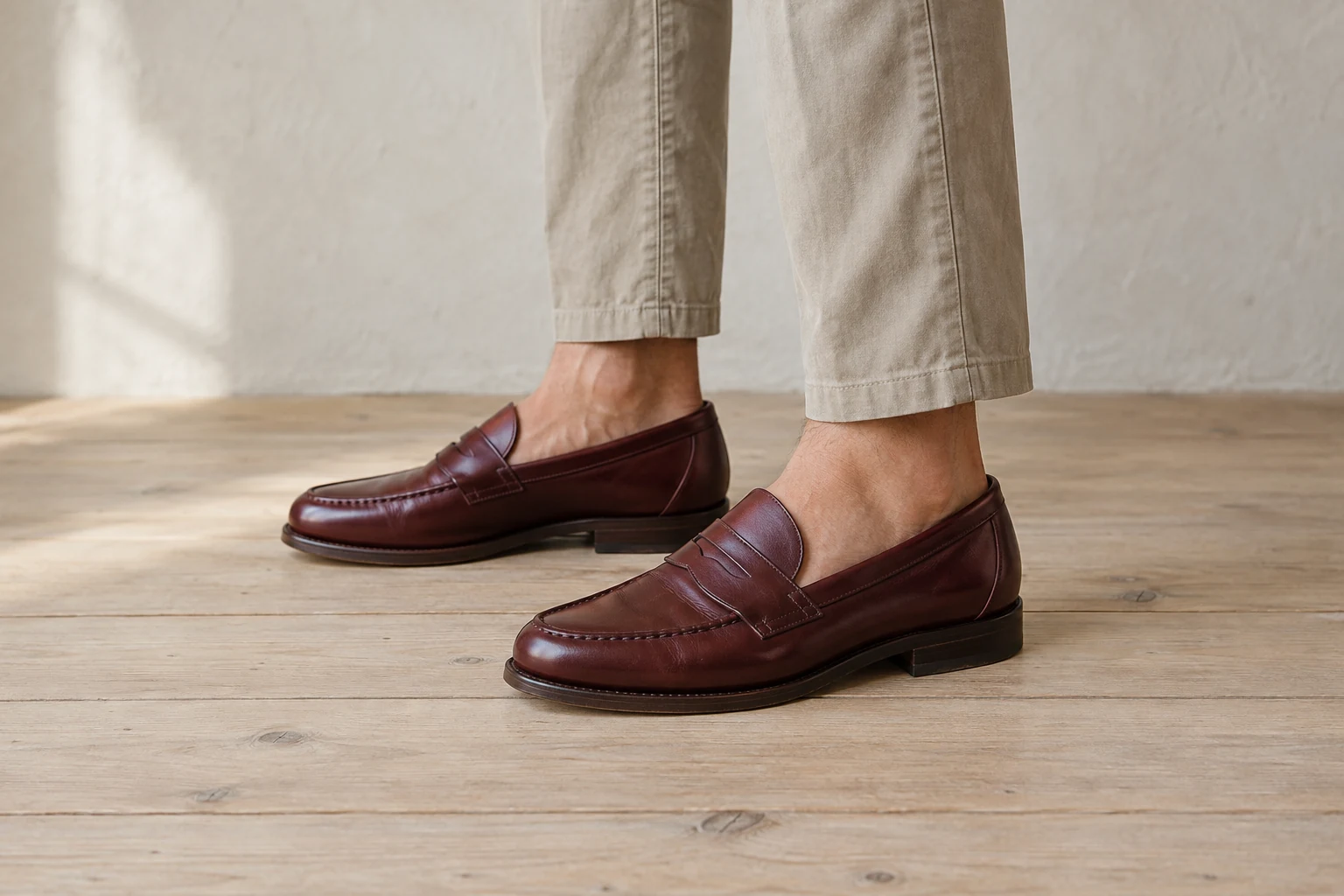
Knitwear matters as much as tailoring. Shetland crew necks, cable knits, cardigans and sweater vests appear constantly in old campus photos, along with repp striped and knit ties worn slightly loose. Shoes are penny loafers, plain toe bluchers, white canvas sneakers, and in winter duck boots or chukkas. Belts are often canvas or woven, and socks range from argyle to none at all in summer. Fabrics are natural and textured: cotton oxford, flannel, tweed, corduroy and madras.
Black Ivy and Japanese Ivy
Two traditions did the most to keep Ivy style alive and to make it cool. In the middle of the twentieth century, Black men in America, including musicians, writers and civil rights leaders, adopted the Ivy look and made it their own. The writer Jason Jules documented this in Black Ivy: A Revolt in Style, published in 2021, which shows figures such as Miles Davis, John Coltrane, James Baldwin, Sidney Poitier and Malcolm X in oxford shirts, three button jackets, repp ties and loafers. In their hands the clothes of an exclusive elite became sharper, more confident and more personal, which is the energy many people mean today when they talk about black Ivy style.
In Japan, Ivy became a passion of its own. In 1965 four Japanese enthusiasts connected to the clothing company VAN Jacket published Take Ivy, candid photographs of students on American campuses, and the book became a style bible for a generation. W. David Marx's book Ametora describes how Japanese makers and shops went on to study and perfect these American classics. Japanese Ivy style today is often more precise than the original, with careful fits, rolled cuffs and small details, and Tokyo menswear shops are one reason the look reached young people worldwide again.
Ivy style outfits for men
For class or a casual workday, wear a light blue oxford button down with the sleeves rolled twice, khaki chinos with a small cuff that sits just on the shoe, a navy Shetland crew neck in cool weather, and white canvas sneakers or brown penny loafers. That single outfit is the core of the style, and every other look is a variation. For a date or a dinner, keep the oxford and chinos but add a navy blazer with a soft shoulder, and swap the sneakers for loafers.
For a rugged Ivy style weekend, try dark jeans, a faded oxford or a flannel shirt, a waxed or canvas field jacket, a cable knit sweater and chukka boots or duck boots. In summer, go for a madras shirt, stone chinos or shorts that end above the knee, and loafers without visible socks. For a dressier occasion, a gray flannel or tweed jacket with a repp tie, an oxford shirt and gray trousers looks right at a wedding rehearsal or a smart party. Our guide to wearing loafers covers socks and trouser length.
The Ivy League haircut
The Ivy League haircut is a longer version of the crew cut: short, tapered sides and back, with enough length on top to comb to the side and wear a part. A long crew cut is often graduated from about 1.5 inches (3.8 cm) at the front hairline down to about half an inch (1.3 cm) at the back of the crown, and the Ivy League version keeps the front long enough to part. It looks neat without looking stiff, which suits the clothes.
Ask your barber for a scissor cut or a longer guard on the top, a taper rather than a skin fade on the sides, and a natural side part. Style it with a little matte cream so it moves. The Ivy look does not require this cut, though. Softer, slightly longer hair with a natural wave, or a modern curtain bang, can look just as good with an oxford shirt and a sweater, especially if you want the Japanese or Korean take on the style.
How to wear modern Ivy style without a costume
Modern Ivy style works when it looks lived in. A brand new, stiff shirt, pressed chinos and polished shoes all at once can feel like a uniform, while a soft oxford, chinos with a little fade and scuffed loafers look like your own clothes. Let one thing be slightly relaxed or worn, and keep the fits easy rather than slim: a straight or slightly wide chino and a shirt with some room through the body look closer to the 1960s photos than skinny cuts.
Mixing is also what keeps it current. Pair an oxford shirt and a navy sweater with wide jeans and chunky sneakers, or a tweed jacket with a hoodie underneath. Start from what you already own, which for most men includes a blue button down shirt, chinos and a crew neck sweater, then add a pair of loafers and, later, a navy jacket with a soft shoulder, both of which turn up often in thrift shops. Our guide on dressing well as a man covers the fit basics that make any of this look right.
Common mistakes
Turning it into preppy costume
Pink shorts, a popped collar and a sweater tied around the neck all at once read as a caricature. Keep Ivy colors calm and let texture carry interest.
Wearing everything slim and new
Ivy clothes were relaxed and looked better with age. Choose straight trousers and soft collars, and do not be afraid of a little fading.
Ignoring trouser length
Chinos pooling over the shoe look sloppy with loafers. Hem them to just touch the shoe or add a small cuff.
Questions people ask
What does Ivy style mean?
Ivy style means the American campus look that developed at Ivy League universities from the 1920s and peaked in the late 1950s and early 1960s. It is built on oxford button down shirts, chinos, soft shouldered jackets, knitwear and loafers.
What are examples of casual Ivy style clothing?
An oxford button down shirt, khaki chinos, a Shetland crew neck sweater, white canvas sneakers or penny loafers, and a canvas belt are the classic casual pieces. For weekends, add dark jeans, a flannel shirt and a field jacket.
What is the difference between Ivy and old money style?
Ivy is a historic menswear style with specific pieces and fits from mid century American campuses. Old money style is a recent internet term for quiet, expensive looking clothing that borrows from Ivy, preppy and European resort dressing.
Can women wear Ivy style?
Yes. Women have long borrowed oxford shirts, chinos, crew neck sweaters, blazers and loafers, and the look works beautifully with a pleated skirt or straight trousers. The same rules of calm color, natural fabric and a lived in feel apply.
Sources and further reading
References used for this guide. Each opens the original page in a new tab.
- Ivy League (clothing), Wikipedia history, key garments and relation to preppy Opens in a new tab
- Take Ivy, Wikipedia entry on the 1965 Japanese photo book Opens in a new tab
- Black Ivy: A Revolt in Style by Jason Jules, publisher description, ARTBOOK D.A.P. Opens in a new tab
- Ametora: How Japan Saved American Style by W. David Marx, Basic Books description Opens in a new tab
- Crew cut, Wikipedia entry including the Ivy League variation Opens in a new tab
Keep reading
Styles
Preppy style: what it is and how to wear it now
What preppy style means, where it came from, the core pieces for men and women, and how to wear modern preppy outfits without looking like a costume.
Styles
Old money style and quiet luxury, explained
What old money style and quiet luxury actually mean, the pieces, colors and fabrics behind them, and outfits for men and women that work without a big budget.
Fabrics
Oxford cloth: why the oxford shirt works everywhere
What an oxford cloth shirt is: the basketweave, oxford vs pinpoint and royal oxford, how it compares to a dress shirt, how to wear it and how to care for it.
Styles
Japanese street style: the looks, pieces and outfits
Japanese street style explained: where it came from, the main Tokyo looks from city boy to Harajuku, the key pieces, and outfits for men and women to try.
Everyday style
How to wear loafers, with or without socks
How to wear loafers for men and women: when to wear socks or no show socks, which pants and hem lengths work, outfits with jeans, suits and dresses.