How to clean suede shoes without flattening the nap
In this guide
You notice it on the way home: a dark scuff across the toe of your tan suede loafers, or a pale tide line where a puddle splashed your chukkas. Suede looks fragile, so the instinct is either to leave it alone or to attack it with a wet cloth and soap. Neither helps. Knowing how to clean suede shoes mostly comes down to working dry first, using very little liquid, and drying slowly so the surface stays soft and even.
Suede forgives more than smooth leather in one respect. Its fuzzy surface, the nap, hides small scratches, and a brush can often lift a mark that would need polish on a calf shoe. What suede does not forgive is soaking, heat and rubbing a stain while it is wet. The routine below keeps to that logic, from everyday brushing to rain damage and the rare case where a specialist is the better call.
Why suede needs its own routine
Suede is leather that has been buffed on the inner side of the hide until the fibers stand up into a soft pile. Nubuck is similar but buffed on the outer, grain side, so its nap is finer and shorter. Roughout, common on work boots, is sturdier again. All three have open fibers that drink in water, oil and dirt, which is why they stain easily and why the cream and wax you would use on smooth leather would mat the surface down instead of shining it.
Crockett and Jones recommends keeping a brush just for suede and never sharing it with the brushes you use to polish calf shoes, because polish residue on the bristles would transfer straight into the nap. A basic kit is small: a suede brush with brass or stiff nylon bristles for dirt, a rubber or crepe side or block for lifting the pile, a suede eraser, shoe trees or crumpled paper, and a protector spray. Nubuck and roughout use the same tools, with a lighter hand on nubuck.
How to clean suede shoes at home, step by step
This routine handles everyday dust, light scuffs and dried mud. Work somewhere with good light so you can see the nap change as you go, and give yourself ten minutes per pair.
Let the shoes dry and give them a shape
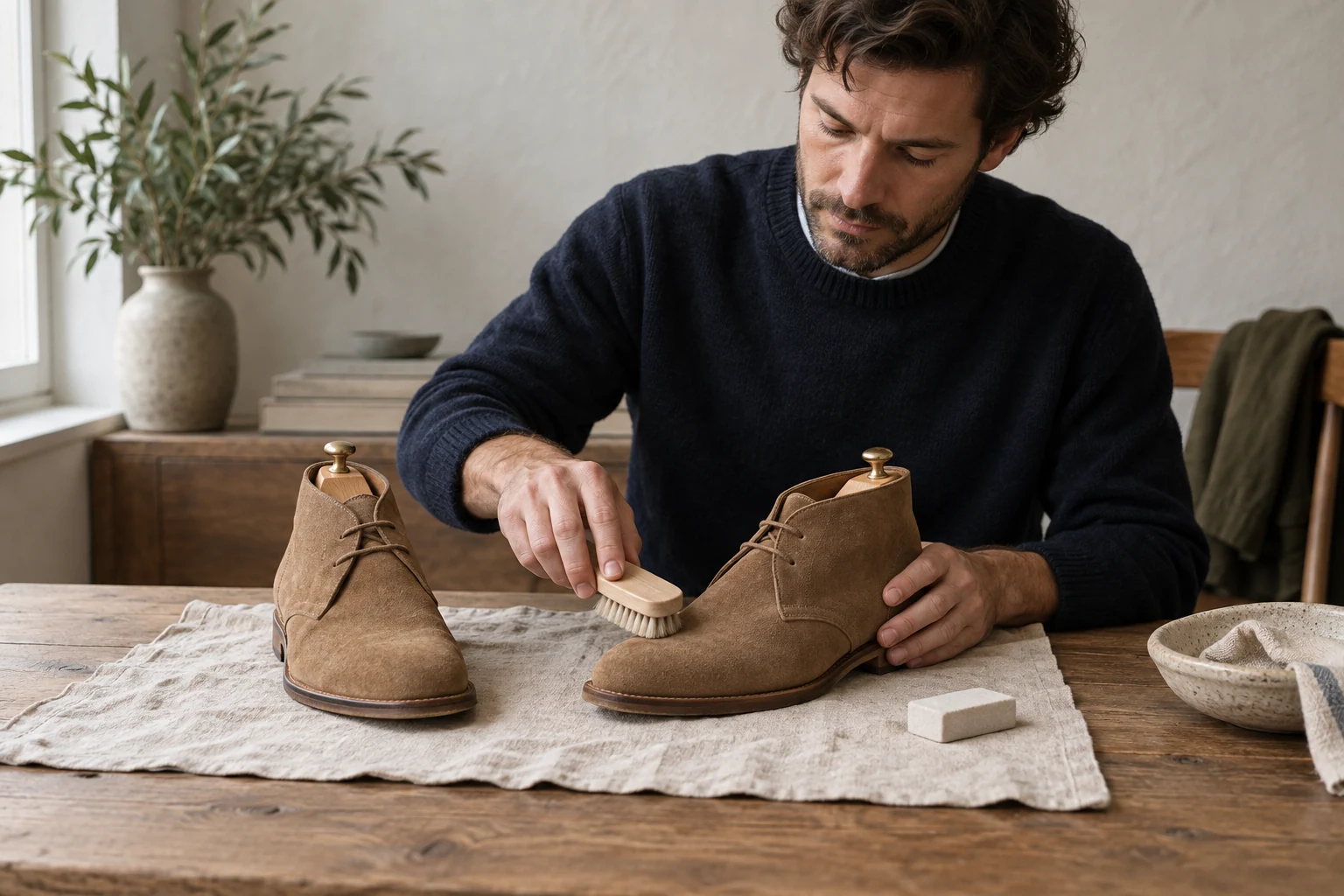
If the shoes are damp or muddy, leave them until they are completely dry. Nike's care guide warns that brushing wet mud pushes it into the suede. Put shoe trees or crumpled paper inside so the upper is firm under the brush; a collapsed toe creases and makes even pressure impossible.
Brush off the loose dirt
Use the bristle side of the suede brush with short, light strokes, first in one direction to remove dust, then against it to open up the pile. Pay attention to the welt and the seam where upper meets sole, where grit collects.
CheckYou should see the color look more even and slightly lighter as the dust comes out.
Erase scuffs and shiny patches
Rub any remaining mark with a suede eraser, using short back and forth strokes and modest pressure, then brush away the crumbs. The eraser works by gripping and lifting dirt out of the fibers, and it also roughs up spots that have been pressed flat and shiny. A clean white pencil eraser is a reasonable stand in on dark suede, though test it on the heel first.
Raise the nap
Go over the whole shoe with a rubber or crepe brush, letting it catch the pile rather than pressing hard. Crockett and Jones describes this as drawing out the nap. The surface should look velvety and uniform, without flattened tracks.
Protect the clean shoes
On clean, dry suede, mist a protector spray made for suede in a ventilated room, holding the can at the distance its label gives and working in light, even passes rather than one heavy coat. Let it dry, then brush lightly. Protection does not make suede waterproof, but it gives you time to blot a spill before it soaks in.
What to use when brushing is not enough
For marks that survive the brush and eraser, a dedicated suede cleaner for shoes is the safest next step because it is made to lift soil without leaving a ring. Most are applied with a brush in small circles, and Jason Markk stresses wiping away the excess afterward so the panel dries evenly. Red Wing's instructions for its roughout eraser bar take the same careful approach: if a stain remains, dampen the bar and repeat, then let the leather dry before brushing. Allow a full day of drying before you judge the result.
If you want to clean suede shoes without suede cleaner, Nike suggests white vinegar or rubbing alcohol on a cloth. Keep the cloth barely damp, never wet. Both liquids evaporate quickly, which is why they are less likely to leave a water mark than plain water, but either can shift some dyes, so test on the inside of the heel first. Dab, let dry, then brush the nap back up.
Other household products are less reliable. Dish soap works on grease elsewhere, but on suede it means adding water and suds that have to be rinsed out, which is how rings and stiff patches start; save it for the rubber soles and use it on the upper only as a last resort, as a trace of suds on a damp cloth over a whole panel. A melamine sponge such as a Magic Eraser is a fine abrasive. It can clean a rubber midsole beautifully and it can also sand away the nap and some of the dye on suede, so keep it off the leather.
Oil and grease need a different approach, since liquid spreads them. Cover a fresh oil spot with cornstarch or baking soda, leave it for several hours so the powder can draw the oil out, then brush it away and repeat if a shadow remains. For chewing gum or candle wax, harden it in the freezer inside a bag and peel or crack it off. Ink, red wine and paint, especially on pale suede, are reasons to stop and take the shoes to a cobbler who cleans suede before home experiments set the stain.
| Problem | First move | Avoid |
|---|---|---|
| Scuffs and dried dirt | Brush, then suede eraser, then raise the nap | Brushing while still wet |
| Marks that survive the eraser | Dedicated suede cleaner, then wipe excess | Dish soap suds on the leather |
| Fresh oil or grease | Cornstarch or baking soda for several hours | Any liquid, which spreads it |
| Gum or candle wax | Freeze in a bag, then crack it off | Scraping it while soft |
| Ink, red wine or paint | Take them to a cobbler | Home experiments that set the stain |
Rain, snow and water stains
Getting wet does not ruin suede by itself. A light shower, dried slowly and brushed, usually leaves no trace. The damage comes from soaking, from dirty or salty water left to dry in the fibers, and from drying the shoes too fast with heat.
If you get caught in the rain, blot the shoes with a towel as soon as you are inside, stuff them with paper or insert wooden shoe trees, and let them dry at room temperature for a day or more. Keep them well away from radiators, heaters and hair dryers; heat shrinks and stiffens suede and can weaken the glue in the sole. Once dry, brush the whole shoe to lift the pile that the water pressed down. Between wears, keep them somewhere dry and airy rather than in a sealed box; our guide to storing shoes covers the details.
A water ring forms because the wet patch dries from the outside in and leaves dissolved dirt concentrated at its edge. The approach many cobblers use is to remove the edge rather than the spot: dampen the entire panel evenly with a lightly moistened cloth or brush, working from the ring outward so there is no new boundary, then let it dry on trees and brush. It is not guaranteed on every suede, so try it first on a less visible panel. Crockett and Jones also mentions holding shoes briefly over steam from a kettle to revive a tired nap; keep your hands clear and the leather moving, and brush once it is dry.
Winter road salt leaves white lines as the water evaporates. Brush off what you can once the shoes are dry, then dab the line with a cloth barely dampened with water and a little white vinegar, test first, and dry and brush as before. Doing this soon matters, because salt left in the fibers can keep drying and stiffening the leather.
How to clean white suede shoes
White and pale suede shows every mark, so the method is the same but the timing is tighter. Brush after every few wears instead of waiting for visible grime, and keep one clean brush and eraser only for light colors, since a brush that has worked on brown suede will leave a tint. Clean whole panels rather than spots: a single bright patch on a slightly dusty shoe looks worse than the dust did.
Avoid bleach, colored cleaners and anything oily, and be cautious with stain removers designed for fabric sneakers; many contain brighteners or solvents that can yellow or stiffen suede. If you have white suede sneakers with mesh or rubber parts, clean the suede panels with the suede routine and the rest with the approach in our guide to cleaning white sneakers. Faded suede can be refreshed with a renovating spray in a matching shade, but with white, an exact match is hard, so test inside the heel.
Why suede does not belong in the washing machine
It is tempting to put tired suede sneakers in the wash, and Nike's own guide says not to. Soaking and tumbling push water through the whole hide, and as it dries the fibers stiffen and the nap mats. Dye can bleed unevenly, and the glue that holds many shoes together softens in warm water. The same logic applies to suede jackets and bags: brush them with a suede brush, spot clean carefully, and send a full clean to a specialist, as described in our guide to cleaning a leather jacket.
Suede that has already been through the machine can sometimes be partly rescued. Shape it with paper while damp, dry it slowly at room temperature, then brush vigorously with the bristle side and the crepe side in turn. Expect the texture to be flatter than before; a cobbler can sometimes restore more of it.
Common mistakes
Rubbing a wet stain
Rubbing a spill while it is wet pushes it deeper and spreads the edge. Blot, let it dry, then brush and erase. Most mud and many drinks come out far more easily once dry.
Drying with heat
A radiator or hair dryer dries the surface fast and unevenly, stiffens the leather and can crack it. Room temperature drying with shoe trees takes longer but keeps the shoe in shape.
Using polish or leather cream
Products for smooth leather fill the nap and leave it dark and slick. If your shoes are smooth calf, see our guide to polishing leather shoes; suede needs brushes, erasers and suede specific sprays instead.
Spraying protector on dirty shoes
Protector seals in whatever is on the surface. Clean and dry first, then spray, so the barrier sits over clean fibers.
Questions people ask
Can I use a toothbrush instead of a suede brush?
A dry, clean toothbrush can remove light dust and reach seams, which makes it a useful backup. It will not lift a matted nap as well as a rubber or crepe brush, and its bristles are too soft for dried mud. If you wear suede shoes often, a proper suede brush earns its place.
When should you not wear suede shoes?
Skip untreated suede on days of heavy rain, slush or salted sidewalks, and anywhere you expect deep mud. A protector spray helps with a surprise shower but is not a raincoat. On those days a smooth leather or rubber boot is the better choice, and our guide to what to wear in the rain has more ideas.
Does suede stretch?
Suede stretches more readily than many smooth leathers, but moisture and heat used to stretch it can change its texture. Use gentle, dry methods first and read our guide on how to stretch shoes before adding liquid.
Can I use a suede brush on a jacket?
Yes, the same brush works on suede jackets and bags, with lighter pressure on thin garment suede. Brush along the panels rather than in circles, and keep liquid cleaners for a specialist, because a jacket panel is much harder to dry evenly than a shoe.
How often should I clean suede shoes?
A quick brush after every few wears keeps dirt from settling in, and it takes less than a minute. Do a fuller clean with the eraser whenever marks appear, and reapply protector every few weeks in wet seasons or after a deep clean.
Sources and further reading
References used for this guide. Each opens the original page in a new tab.
- Crockett and Jones: suede shoe care Opens in a new tab
- Red Wing: nubuck and roughout leather care kit instructions Opens in a new tab
- Nike: how to clean suede shoes Opens in a new tab
- Jason Markk: how to clean suede shoes and sneakers Opens in a new tab
- Cobbler Union: how to clean suede shoes step by step Opens in a new tab
Keep reading
Shoes and jewelry
How to polish shoes at home, step by step
How to polish leather shoes at home: clean and condition first, use cream for color and wax for shine, buff properly, and keep the shape with shoe trees.
Shoes and jewelry
How to clean white sneakers by material
How to clean white sneakers at home: a gentle method for leather, canvas and mesh, what to do about soles, laces and yellowing, and why the washer is a last resort.
Shoes and jewelry
How to clean a leather jacket at home
How to clean a leather jacket safely: routine wiping, gentle spot cleaning, when and how to use leather conditioner, what never to do, and when to call a specialist.
Shoes and jewelry
How to stretch shoes that feel too tight
How to stretch shoes that pinch: what leather can and cannot do, using a shoe stretcher and thick socks, the risks of heat and ice, and when to see a cobbler.
Suits and tailoring
How to match your belt, shoes and socks
How to match belt and shoes by color and finish, which buckle goes with your watch, why socks follow the trousers, and when casual outfits let you relax the rules.