How to set a table: the basic place setting
In this guide
Friends are coming for dinner at seven, the food is under control, and you are standing at the table with a stack of plates and a drawer of cutlery, trying to remember which side the fork goes on. Knowing how to set a table takes about five minutes to learn, and it rests on a few rules that explain nearly every arrangement you will meet, from a weeknight supper to a wedding reception.
This guide follows the common American conventions described by the Emily Post Institute, which are close to wider Western practice. Other dining traditions arrange the table differently, and a family's own habits are just as valid at home. Start with the basic setting, then add pieces as the menu grows. When you are ready for the full dinner party version, our guide to the formal table setting picks up where this one ends.
Three rules behind every place setting
Emily Post reduces table setting to three rules. First, utensils are placed in the order they will be used, working from the outside in, so the diner simply takes the outermost piece for each course. Second, forks go to the left of the plate, and knives and spoons go to the right; the only standard exception is a small oyster fork, which sits on the right. Third, set only the utensils the meal needs. No soup means no soup spoon, and a table with fewer pieces is not less polite.
Two memory tricks help. Spell FORKS from left to right: F for fork, O for the round plate, K for knife and S for spoon, ignoring the R. For the small plates and glasses, touch the tip of each thumb to the tip of its forefinger and hold the other fingers up. Your left hand forms a small b, for bread, and your right hand a small d, for drinks. Bread plates belong to the left of each setting, and glasses to the right.
How to set a table for an everyday meal
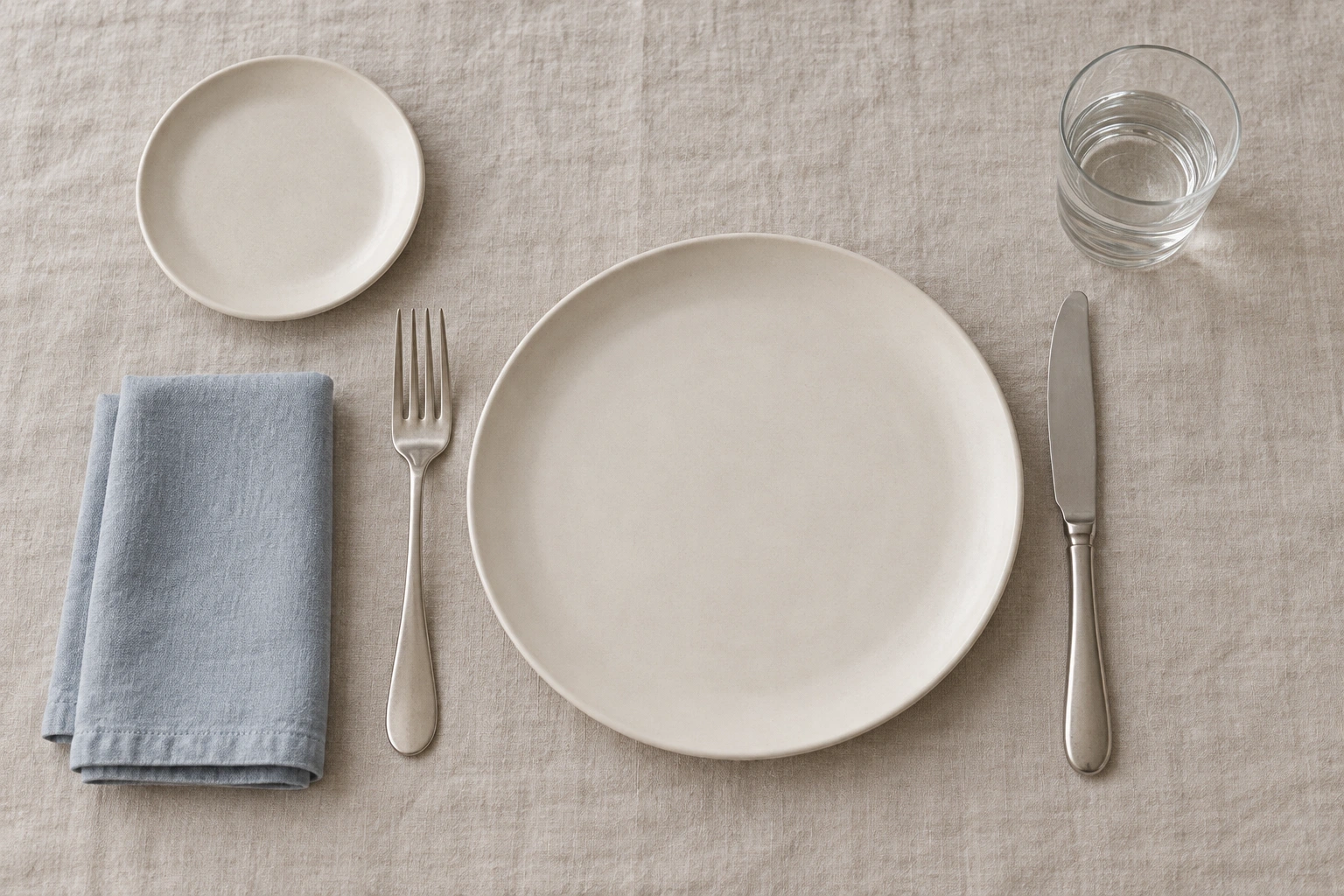
The basic table setting is what most families and many casual restaurants use for a one course meal. Picture it as a table setting diagram seen from the diner's chair and build it in this order.
Put the plate in the center
Set the dinner plate, or a place mat if you use one, directly in front of the chair and a little in from the table's edge. Everything else is arranged around it, so getting the plate centered keeps the whole setting straight.
Lay the fork and napkin on the left
Place the fork to the left of the plate. The napkin goes to the left of the fork, or the fork can rest on top of it; Emily Post also accepts the napkin folded on the plate.
CheckYou should now have the left side finished.
Lay the knife on the right, blade in
Place the knife immediately to the right of the plate with its cutting edge facing the plate. Emily Post treats this as fixed: knife blades always face the plate, whatever else about the setting you vary.
Add a spoon only if needed
If the meal includes soup or anything eaten with a spoon, place the spoon to the right of the knife. If not, leave it off.
Set the glass above the knife
Stand the water glass above the tip of the knife, or at a slight angle above and to the right of it. Check the whole setting: fork and napkin left, plate center, knife and spoon right, glass top right.
How to set a table for dinner: the informal setting
For a dinner of two or three courses, Emily Post describes an informal setting that builds on the basic one. The dinner plate is the hub. Two forks go on the left: the larger dinner fork and a smaller salad fork. If the salad comes first, the salad fork sits on the outside; if salad follows the main course, it sits on the inside, next to the plate. The napkin goes to the left of the forks or on the plate. On the right are the dinner knife, blade facing in, and then the spoons, with a soup spoon on the far right if soup is the first course.
Glasses of every kind, water, wine or iced tea, stand at the top right, above the knife and spoons. A bread plate, if you use one, sits above the forks, with a small butter knife laid across its edge, handle to the right. Dessert spoon and fork can be laid horizontally above the plate, the spoon on top with its handle pointing right and the fork beneath with its handle pointing left, or they can arrive with dessert. If coffee is served during the meal, the cup and saucer go above and to the right of the knife and spoons; at home, most hosts bring them out after dinner.
| Piece | Where it goes | Detail |
|---|---|---|
| Forks | Left of the plate | Salad fork outside if salad comes first |
| Knives | Right of the plate | Blade always faces the plate |
| Spoons | Right of the knife | Soup spoon far right; only if the meal needs one |
| Napkin | Left of the forks, or on the plate | Into your lap as you sit down |
| Bread plate | Above the forks | Butter knife across the edge, handle to the right |
| Glasses | Top right, above knife and spoons | Water, wine or iced tea |
| Dessert fork and spoon | Horizontal above the plate | Spoon on top, handle right; fork below, handle left |
Setting a table for a dinner party
A longer menu adds pieces, but the logic stays the same: each course gets its own utensil, placed so the diner works inward. Emily Post notes that the order can shift with the menu. A soup served between salad and the main course moves the soup spoon between the two knives, and a charger plate or a separate glass for each wine are options rather than requirements. The fully formal version, with place cards, a fish course and a line of glasses, is covered in our guide to the formal table setting diagram and rules.
The number of guests changes the layout of the table more than the settings themselves. For two, set the places across from each other at the middle of the table rather than at the ends, or at a corner if the table is long, so you are close enough to talk and pass dishes. For four, put one setting on each side of a square or round table, or two facing two on a rectangle, and center each setting on its chair. A lunch table follows the same logic as dinner with less on it: usually the basic setting, a lunch or salad plate instead of a large dinner plate, and a spoon only if soup or iced tea is served.
Practical hosting matters as much as correctness. Leave enough room between settings for elbows and for each person to reach their own glass without crossing a neighbor. If you lack a full set of matching cutlery, Emily Post points out that salad forks can double as dessert forks; a clean fork brought with dessert is fine. Before dessert, clear everything that was not used, including the bread plates. If your invitation names a dress code, our guides to dressy casual and semi formal attire help guests dress to match the table.
Reading a place setting as a guest
When you sit down to a set table, find your own setting before you reach for anything. Your bread plate is on your left and your glasses are on your right, which settles the common confusion over whose roll is whose. According to the Institute, Emily Post herself often mixed them up, and simply offered her own plate when a neighbor noticed. Put your napkin in your lap as you sit down, and at a hosted meal it is customary to wait for the host to start or to invite you to begin.
For each course, take the outermost utensil on each side. If a server brings fresh cutlery with a dish, use that instead. Dessert pieces laid above the plate wait until the end. When wine is poured, hold the glass by its stem so your hand does not warm the wine or smudge the bowl; our guide to holding a wine glass shows the grip. If you are left handed, the setting is arranged for right handed diners, so switch utensils between your hands as you need to.
Signaling you have finished, and small mishaps
Emily Post's advice is to show you have finished by placing your knife and fork together on the plate with the handles resting at about four o'clock, as if the plate were a clock face. Leave the plate where it is rather than pushing it away. Service customs differ across countries and restaurants, so if someone starts to clear too early, just say you are still eating.
Mishaps happen at every table. If you drop a utensil, leave it and ask the server for another, unless it is somewhere that someone could step on it. If you knock over a glass, set it upright, apologize, use your napkin to stop the spread and ask for help with the rest. A smudged glass or fork can be replaced with a quiet word to the server rather than polished with your napkin. None of these needs an announcement; the aim of the whole arrangement is that people can eat and talk comfortably.
Common mistakes
Setting utensils nobody will use
Extra forks make a table look busy and leave guests guessing. Emily Post's rule is to set only what the menu calls for; add pieces for a course when it arrives if needed.
Turning the knife blade outward
The cutting edge always faces the plate. It is one of the few details in a basic setting that everyone notices.
Putting glasses on the left
Drinks belong at the top right, above the knife. When glasses drift to the left, neighbors reach for the wrong one, just as with misplaced bread plates.
Crowding the settings
A perfectly arranged setting is uncomfortable if elbows collide. For a large group, use fewer pieces per person rather than squeezing in a full informal setting.
Questions people ask
Which side does the napkin go on?
On the left, beside the fork or under it, or folded in the center of the plate. Emily Post accepts all of these, and notes that some hosts avoid putting the fork on the napkin so guests do not have to move the fork to reach it.
Where do the wine glasses go in a table setting?
Above the knife on the right, alongside the water glass. At an informal dinner there is usually one wine glass, perhaps two. When several wines are served, the glasses form a small group to the right of the setting.
What is the difference between a basic, informal and formal table setting?
A basic setting has one fork, one knife, perhaps a spoon, a napkin and a glass, for a one course meal. An informal setting adds utensils for two or three courses, such as a salad fork, soup spoon, bread plate and dessert pieces. A formal setting is used for longer menus of more than three courses and adds pieces such as a fish fork, a charger and several glasses.
Where does the dessert spoon go?
Either horizontally above the plate, with the spoon on top and its handle pointing right, or brought to the table with dessert. Emily Post calls spoon above fork the traditional order, though you will also see them the other way round.
What are some table setting ideas for everyday meals?
Keep it to the basic setting: a plate in the center, fork and napkin on the left, knife on the right and a glass above it. A cloth napkin and a pitcher of water make an ordinary dinner feel set without adding work. Emily Post also accepts placing all the utensils together on the napkin to the left of the plate.
Sources and further reading
References used for this guide. Each opens the original page in a new tab.
- Emily Post Institute, basic table setting Opens in a new tab
- Emily Post Institute, proper table setting guides Opens in a new tab
- Emily Post Institute, informal table setting Opens in a new tab
- Emily Post Institute, top table manners tips Opens in a new tab
- Emily Post Institute, top questions for dining out Opens in a new tab
Keep reading
At the table
Formal table setting: how to set a formal dinner table
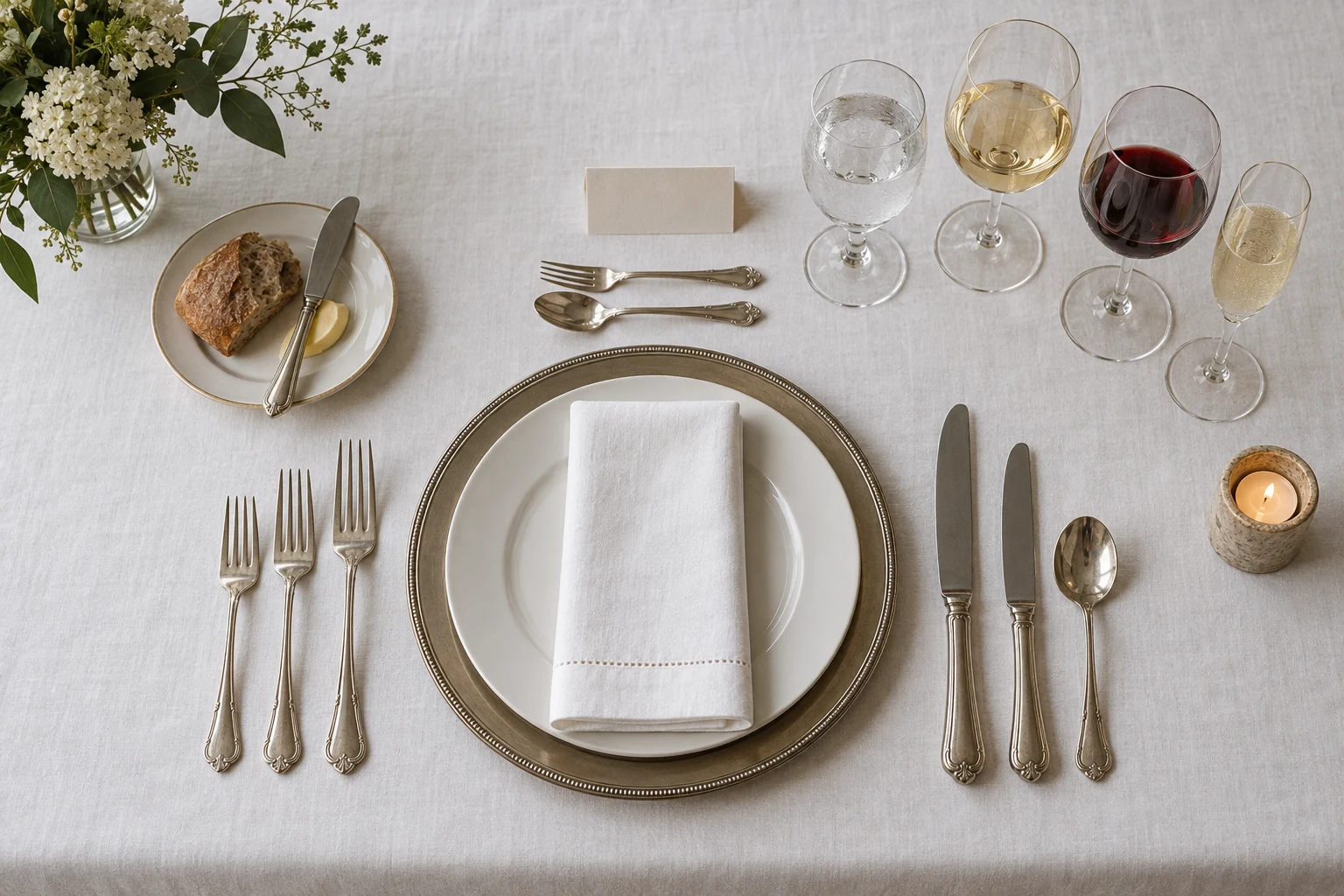
How to set a formal table: cutlery from the outside in, glasses in order of use, the bread plate, dessert cutlery and place cards, following Emily Post.

At the table
How to hold a wine glass, and other small table habits
How to hold a wine glass by the stem and why, how to toast, and how to hold a fork and knife in the American and Continental styles, with where to rest them.

Dress codes
Dressy casual: what it means for men and women
What dressy casual means on an invitation, with outfits for men and women, whether jeans count, and how a dressy casual wedding differs from a party or dinner.
Dress codes
Semi formal attire for men and women
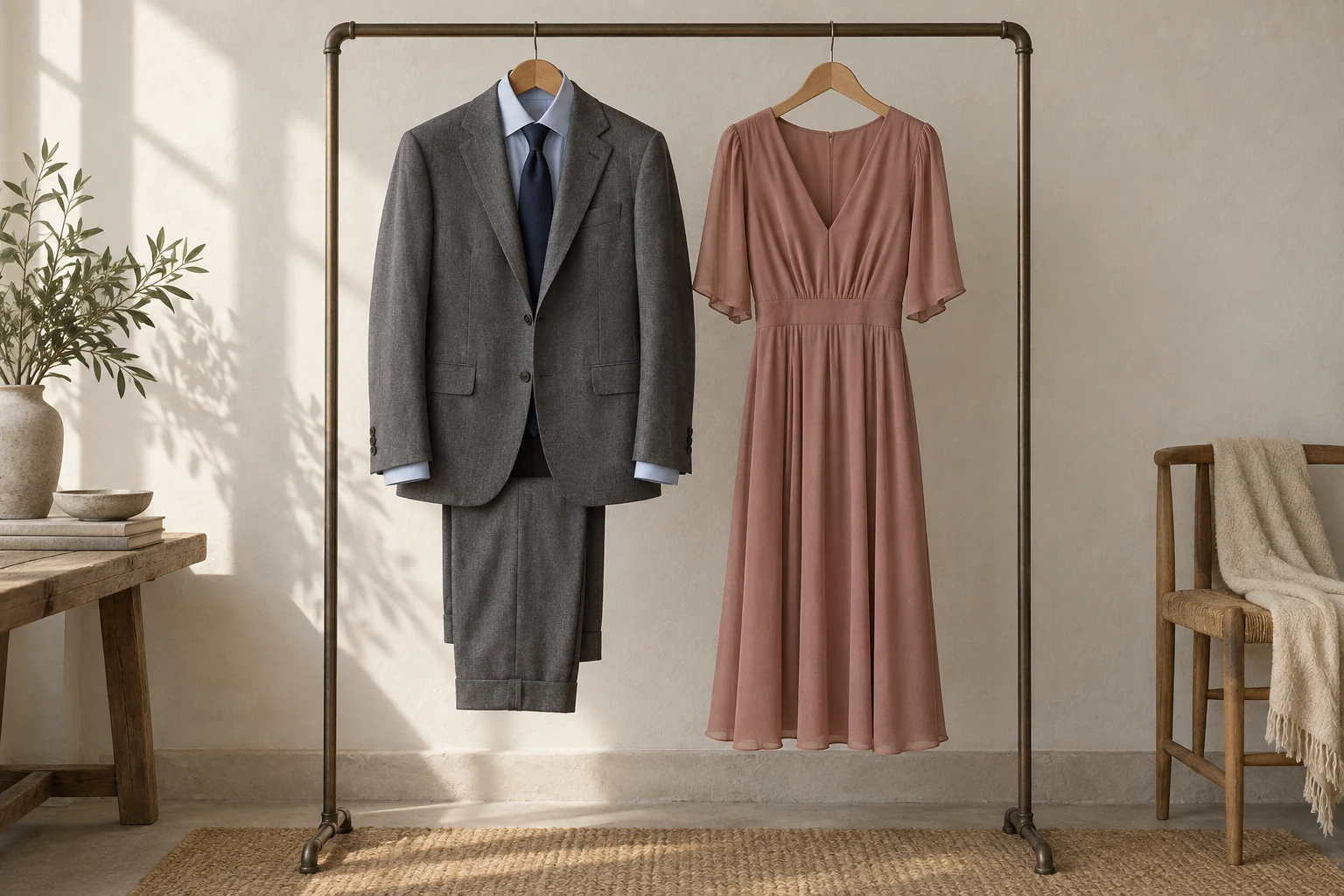
What semi formal attire means for men and women, how daytime and evening change it, and what to wear to a semi formal wedding, party or dance, with outfit ideas.